פרשת ויקהל: וְכׇ֨ל־הַנָּשִׁ֔ים אֲשֶׁ֨ר נָשָׂ֥א לִבָּ֛ן אֹתָ֖נָה בְּחׇכְמָ֑ה טָו֖וּ אֶת־הָעִזִּֽים
פרשת ״ויקהל״ מספרת על אחד הניסים הכי גדולים בהיסטוריה של עם ישראל. יתכן שהאמירה הזו מפתיעה. כשאני אומרת את זה, אנשים אומרים לי, ׳רגע, לא התבלבלת? מה עם קריעת ים סוף? הסנה הבוער ואינו אוכל? עשרת המכות, יציאת מצרים, ובכלל, בריאת העולם׳? וזה נכון, אלא שכל הנסים האלו נעשו ע״י הקב״ה, והקב״ה, בהגדרה, יכול לעשות הכל. לכן אין הבדל בין סנה בוער וים שנקרע, וכל מה שנעשה על ידי הקב״ה הוא מעל ומעבר, אבל אנחנו, זה כבר סיפור אחר.
וכך בבנין המשכן. נתאר לעצמנו מצב כזה בימינו: אנחנו מוזמנים להביא ממה שיש לנו, ממה שמתחשק לנו לתת – זהב, כסף, עץ, מתכות, בדים. אנחנו נותנים, ואפילו בנדיבות ועין יפה. אנחנו עוקבים במדויק אחרי ההוראות שניתנו לנו (נס בפני עצמו!), וכשאנחנו מחברים את הכל ביחד, אנחנו יוצרים במדויק את המבנה המדהים הזה שנקבע מראש, את המשכן. לא חסר שום דבר, ואין שאריות. הכל ״די והותר״. זהו, אכן, נס.
הפרשה השקטה אך המפתיעה בדרכה, גם לא נפתחת במילים הכמעט רגילות שאנו מצפים להן: ׳וידבר ה’ אל משה לאמר, הקהל את העם’… אלא ב״וַיַּקְהֵ֣ל מֹשֶׁ֗ה״ – משה הוא זה שמקהיל את העם. מי אמר לו לעשות זאת? מי אמר להם לבוא? אבל כל עדת בני ישראל התאספו יחד (שמות ל”ה, א) כאומרים, ׳אנחנו כולנו יחד רוצים ליצור מרחב מתאים ונכון לקב״ה בתוכנו׳. כך, הספר שהתחיל בעבדות לפרעה, מסתיים בכך שאנחנו משתפים פעולה ועובדים ביחד, ברצון, למען המטרה והמסע שלנו.
בתוך הרשימה הארוכה של העשיה למען המשכן, אנחנו מוצאים:
וְכׇ֨ל־הַנָּשִׁ֔ים אֲשֶׁ֨ר נָשָׂ֥א לִבָּ֛ן אֹתָ֖נָה בְּחׇכְמָ֑ה טָו֖וּ אֶת־הָעִזִּֽים״ (שמות ל”ה, כ”ו).
רגע… לא חסרה מילה בפסוק? מה פירוש ״טוו את העיזים״? לא היה צריך להיות ״טוו את שיער העיזים״! אך התורה לא אמרה אלא שהנשים – טוו את העיזים.
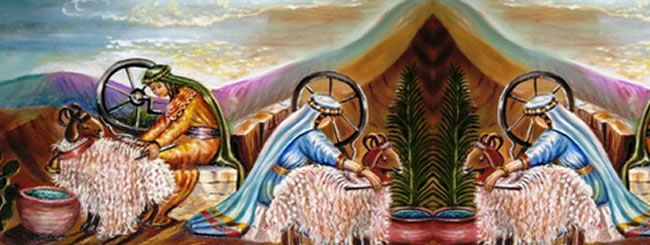
רש״י מפרש בהתבסס על התלמוד ש״טוו את העזים״ הִיא הָיְתָה אָמָּנוּת יְתֵרָה, שֶׁמֵּעַל גַּבֵּי הָעִזִּים טוֹוִין אוֹתָם (שבת ע”ד), כלומר, שאכן נדרשה מיומנות יוצאת דופן, שכן הנשים טוו את שיער העזים ישירות מגב העזים,
הספורנו מוסיף ש״מעל העזים, כדבריהם ז”ל (כדבריו של רש״י וחז״ל) למען יהיה בטווי זהר נוסף, כי בהרבה מהפשוטים ימעט קצת מטוב איכותם כאשר יעקרו ממקום גדולם״… כלומר, הטוויה מעל העיזים אינה טעות כתיב אלא יכולת אומנותית נעלה שנעשה במיוחד כך, כדי לשמר את החיות המקורית שהייתה בשיער העיזים. והמלבי״ם מדגיש את כך שזו ״מלאכה גדולה וצריך חכמה יתירה״ שהיתה בנשים שעבדו על כך.
כך גם מספר התלמוד (שבת צט:א – עם פירוש הרב עדין שטיינזלץ):
תנו רבנן [שנו חכמים]: היריעות התחתונות של המשכן היו של תכלת ושל ארגמן ושל תולעת שני ושל שש. ועליונות — של מעשה עזים, אף שמעשה עזים נחשב זול ופשוט. ואולם גדולה חכמה שנאמרה ביריעות העליונות יותר ממה שנאמרה בתחתונות. שאילו בתחתונות כתיב [נאמר]: “וכל אשה חכמת לב בידיה טוו ויביאו מטוה את התכלת ואת הארגמן את תולעת השני ואת השש“ (שמות לה, כה), ואילו ביריעות העליונות כתיב “וכל הנשים אשר נשא לבן אתנה בחכמה טוו את העזים (שמות לה, כו), ומשמעות לשון “נשא לבן” מורה על חכמה יתירה, והרי שטוויית יריעות העיזים היתה אומנות גדולה יותר מהכנת התכלת והארגמן. וכעין ביאור לדבר תניא [שנויה ברייתא] משום (משמו של) ר’ נחמיה: שמטווה זה היה שטוף שרחצו את השיער על גבי העזים עצמן ואף טווי מן העזים, כלומר, בעודו מחובר בעיזים, ואומנות כזו דורשת חכמה יתירה.
הרש״ר הירש טוען שכיון שתיבת בחכמה באה כאן בתוספת ל״נשא ליבן וגו׳״, לא יתכן לפרשה במובן של תבונת כפיים, אלא היא מאפיינת את ההחלטה שאליה נשאן ליבן. בשעה ששאר הנשים המאומנות במלאכת יד הזדרזו להכין את הבדים הדרושים להתקנת יריעות הפאר של המשכן, בחרו החכמות שביניהן להתקין את יריעות העיזים. הללו היו פחות מפוארות, אבל חיוניות לגבי משירת מיכלול המשכן, שהרי הן היו עיקר האוהל, ובמושג האוהל מתגלמת, כידוע, עיקר מהותה של תכונת האשה. בכך הוכיחו הנשים הללו את שאר רוחן ואת תבונת נפשן הנשית האמיתית, ושני אלה קרויים כאן ״חכמה״. כך מתבארת גם צורת ההטעמה ״אֹתָ֖נָה״. אמנם התלמוד (שבת צט:א) מציין כבלתי רגילה גם את עצם מלאכת האומנות שבה טוו נשים חכמות אלה את יריעות העיזים: ״שָׁטוּף בָּעִזִּים וְטָווּי מִן הָעִזִּים״, היינו שטוו אותן ישירות ״על גבי בהמה״ (שם עד ע״ב). ״שטיפת״ השערות מציינת כנראה הפרדת השערות מן הגוף ללא הסבת כאב, כדרך ששערות הבהמה נושרים מגופה בשעת ה״שטיפה״ במים, בלא שהדבר גורם כאב לבהמה.
אז יושבות שם הנשים בקבוצות קבוצות, שוזרות שמים וארץ להשלמת המשכן. צבעי השמים – תכלת וארגמן – נשזרים קרוב יותר לאדמה, בעוד שערות העיזים החומות, החמות בצבעי אדמה – נשזרות בגובה. המילה עיזים עצמה מזכירה לנו את עוזן של הטוות המביאות עוז, כוח, אומץ, מאז ועד היום, למשכן. כך, הנשים שהתחילו את ספר שמות כשהן עוסקות בהצלת העם מעבדות, גם משאירות כעת את חותמן האומנותי והרוחני כשאנחנו מגיעים כמעט לסופו של הספר הזה.
שבת ״פרה״ שלום
Parashat VaYak’hel: “And all the women whose hearts lifted them so in wisdom, spun the goats”…
Parashat Vayyakhel tells of one of the greatest miracles in the history of the Jewish people. This statement may be surprising. When I say this, people say to me, ‘Wait a minute, aren’t you confused? What about the parting of the Sea? The bush that burns and is not consumed? The ten plagues, the Exodus from Egypt, and in general, the creation of the world’? And all that is true, except that all of these actions were done by the Holy One, and Gd, by definition, can do anything. Therefore, there is no difference between a burning bush and a sea that splits, and everything that is done by Gd, which is above and beyond. As for us, that is a whole-nother story.
And so it is with the building of the Tabernacle. Let us imagine such a situation in our day: We are invited to bring whatever we have; what we feel like giving – gold, silver, wood, metals, fabrics. We give, and even generously and with a kind eye. We follow precisely the instructions given to us (a miracle in itself!), and when we put everything together, we manage to – precisely – create this amazing structure that was instructed to us, the Mishkan. Nothing is missing, and there are no leftovers. Everything is “enough and too much”. This is, indeed, a miracle.
The quiet (some will say, boring -) but surprising story in its own way, does not open with the almost usual words we expect: “And the Lord spoke to Moses, saying, Gather the people”… but rather with “And Moses then convoked the whole Israelite community”… Moses is the one who gathers the people. Who told him to do this? Who told them to come? But the entire community of the Israelites came together (Exodus 35:1) as if to say, ‘We, all of us, want to create a suitable and proper space for the Holy One within us.’ Thus, the book that began with us being slaves to Pharaoh, ends with us working willingly in cooperation together for our journey and goal.
Among the long list of actions for the sake of the Tabernacle, we find:
“And all the women who excelled in that skill spun the goats” (Exodus 35:26).
Wait… isn’t there a word missing from this verse? What does “spun the goats” mean? It shouldn’t have been “spun the goats’ hair”! But the Torah only said that the women spun the goats. Rashi’s interpretation, based on the Talmud, is that “spun the goats” was “an extraordinary art, weaving (the hair directly) off the goats’ backs” (tractate Shabbat 74:a), meaning, that extraordinary skill was required to do such a craft.
The Sforno adds that “over the goats’ (backs)”, as the late Rabbis (like Rashi and the Sages) said, is intended so that there would be additional shine in the weaving, because in many of such tasks, the good quality would diminish when they are uprooted from their place of growth”… In other words, weaving the goats is not a typo, but a sublime artistic ability that was done specifically in this way, in order to preserve the original liveliness that was in the goats’ hair. And the Malbim emphasizes that this is “a great work and requires extraordinary wisdom” that the women who worked on it had.
The Talmud also says (Shabbat 99:a; translation from Sefaria):
Our Sages taught: The bottom curtains in the Tabernacle were made of sky blue wool, and of purple wool, and of scarlet wool, and of fine linen; and the top curtains were made of goat hair, even though that material is considered to be inferior and common. However, the wisdom that was stated with regard to the top curtains was greater than that which was stated with regard to the bottom ones. This is because, with regard to the bottom curtains, it is written: “And every wise-hearted woman spun with her hands, and they brought that which they had spun, the blue, and the purple, the scarlet, and the linen” (Exodus 35:25); while with regard to the top curtains, it is written: “And all of the women whose hearts inspired them with wisdom spun the goats” (Exodus 35:26). The phrase “whose hearts inspired them” suggests a greater degree of wisdom. Apparently, spinning the goat’s hair curtains required greater skill than spinning the various kinds of wool. And on a similar note, it was taught in a baraita in the name of Rabbi Neḥemya: The hair was rinsed on the goats, and it was even spun from the goats, which required a great deal of skill.
Rav Samson Raphael Hirsch argues that since the word “in wisdom” comes here in addition to “whose hearts lifted them”, it is not possible to interpret it in the sense of wisdom of their craft, but rather it characterizes the decision to which they turned their hearts. While the other women skilled in handicrafts hastened to prepare the fabrics needed to install the magnificent curtains of the Mishkan, the wise among them chose to install the goat curtains. These were less magnificent, but essential to the overall performance of the Mishkan, since they were the main part of the tent, and the concept of the tent embodies, as is well known, the essence of the female quality.
In this way, these women demonstrated their feminine spiritual strength and soulful wisdom, and both of these are called here “wisdom”. This also explains the unusual form of the word “otana” – them. Indeed, the Talmud (Shabbat 99:a) also notes as unusual the very craft in which these wise women wove the goat curtains: “washed (the) goats and spun from the goats,” meaning that they wove them directly “on the back of the animal” (ibid, b). “Washing” the hair probably indicates separating the hair from the goats’ body without causing them any pain, in the same way that the hair of an animal sheds of its body during “washing” with water, without causing it any pain.
So the women sit there, in groups, weaving heaven and earth to complete the Mishkan. The colors of heaven – blue and purple – are woven closer to the earth, while the brown, warm hairs of the goats – the colors of the earth – are woven higher up. The word izim – goats – in itself reminds us of the strength of the weavers who bring strength, power, and courage, from back then to our own time, to the Mishkan. Likewise, the women who began the Book of Exodus by doing what they can to save the people from slavery, are now also leaving their artistic and spiritual mark as we come almost to the end of this book.
Shabbat “Para” Shalom
| This week we started the last chapter in Tractate Sanhedrin, a chapter that’s called “perek chelek” [taking a part]. Every page in the Talmud is a whole world, and yet, to those who love midrash, anyone who would like to fly with the Gemara, this is The place. Here’s one piece of wisdom (91:a-b):Apropos exchanges with prominent gentile leaders, the Gemara cites an exchange where Antoninos, the Roman emperor, said to Rabbi Yehuda HaNasi: The body and the soul are able to exempt themselves from judgment for their sins. How so? The body says: The soul sinned, as from the day of my death when it departed from me, I am cast like a silent stone in the grave, and do not sin. And the soul says: The body sinned, as from the day that I departed from it, I am flying in the air like a bird, incapable of sin. Rabbi Yehuda HaNasi said to him: I will tell you a parable. To what is this matter comparable? It is comparable to a king of flesh and blood who had a fine orchard, and in it there were fine first fruits of a fig tree, and he stationed two guards in the orchard, one lame, who was unable to walk, and one blind. Neither was capable of reaching the fruit on the trees in the orchard without the assistance of the other. The lame person said to the blind person: I see fine first fruits of a fig tree in the orchard; come and place me upon your shoulders. I will guide you to the tree, and we will bring the figs to eat them. The lame person rode upon the shoulders of the blind person and they brought the figs and ate them.Sometime later the owner of the orchard came to the orchard. He said to the guards: The fine first fruits of a fig tree that were in the orchard, where are they? The lame person said: Do I have any legs with which I would be able to walk and take the figs? The blind person said: Do I have any eyes with which I would be able to see the way to the figs? What did the owner of the orchard do? He placed the lame person upon the shoulders of the blind person just as they did when they stole the figs, and he judged them as one.So too, the Holy One, Blessed be He, brings the soul on the day of judgment and casts it back into the body, as they were when they sinned, and He judges them as one, as it is stated: “He calls to the heavens above and to the earth that He may judge His people” (Psalms 50:4). “He calls to the heavens above”; this is the soul, which is heavenly. “And to the earth that He may judge His people”; this is the body, which is earthly. | השבוע התחלנו את הפרק האחרון במסכת סנהדרין, פרק שנקרא פרק ״חלק״. כל דף בתלמוד הוא עולם ומלואו, ועדיין, לאוהבי דרשות ומדרש, למי שרוצה לעוף עם הגמרא, זה המקום. הנה למשל, חוכמה אחת מיני רבות בפרק (דף צא:א-ב): כיון שמדובר בוויכוחים שהיו בין גדולי ישראל וגדולי אומות העולם מזכירים עוד ויכוח אחר: אמר ליה [לו] אנטונינוס קיסר רומי לרבי: והלא גוף ונשמה יכולין לפטור עצמן מן הדין על מה שחטאו, כיצד? — גוף אומר: נשמה היא שחטאת (חטאה), וראיה לדבר — שמיום שפירשה ממני (שעזבתני בשעת מיתה) הריני מוטל כאבן דומם בקבר. ונשמה אומרת: הגוף חטא, שמיום שפירשתי ממנו הריני פורחת באויר כצפור ואיני מסוגלת לחטוא. אמר ליה [לו] רבי: אמשול לך משל, למה הדבר דומה? — למלך בשר ודם שהיה לו פרדס נאה, והיה בו בכורות (בכורי תאנים) נאות, והושיב בו שני שומרים לשמור את הגן, אחד חיגר שאינו יכול להלך, ואחד סומא, שאף אחד מהם לא יוכל להגיע לפירות הפרדס. אמר לו החיגר לסומא: בכורות נאות אני רואה בפרדס, בא והרכיבני על גבך, ואני אראה לך את הדרך ונביאם לאכלם. רכב חיגר על גבי סומא, והביאום ואכלום. לימים בא בעל פרדס. אמר להן: בכורות (פירות הביכורים) נאות שבפרדס היכן הן? אמר לו חיגר: כלום יש לי רגלים להלך בהן? אמר לו סומא: כלום יש לי עינים לראות את הדרך? מה עשה בעל הפרדס שהבין כיצד נעשתה ההערמה? הרכיב חיגר על גבי סומא כדרך שחטאו, ודן אותם כאחד. אף הקדוש ברוך הוא לעתיד לבוא מביא נשמה וזורקה שוב בגוף, ודן אותם כאחד כדרך שחטאו כשהיו יחד, שנאמר: “יקרא אל השמים מעל ואל הארץ לדין עמו” (תהלים נ, ד). “יקרא אל השמים מעל” — זו נשמה שהיא העליונה, “ואל הארץ לדין עמו” — זה הגוף. |


 Torah & more... תורה ועוד