Light up the path…

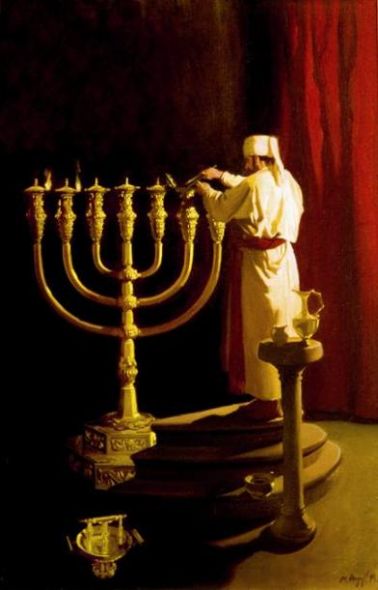
There are 10 different topics and stories in this week’s reading, opening with Aaron lighting the Menorah. The Menorah was made of 7 branches, 9 flowers, 11 knobs and 22 cups (as described in Exodus 25:31-29). The Kabbalists say that the Menorah is like the whole Torah because it constantly sheds light. They tell us how its construction symbolizes it:
In the 1st verse of the Book of Genesis, there are 7 words, like the 7 branches;
In the 1st verse of the Book of Exodus, there are 11 words, like the 11 knobs;
In the 1st verse in the Book of Leviticus, there are 9 words, like the 9 flowers;
In the 1st verse of the Book of Deuteronomy, there are 22 words, like the 22 cups;
Finally, in the 1st verse of the Book of Numbers, there are 17 words, like the 17 tefachim of the Menorah’s height (a tefach is a Biblical measurement of about one fist wide).
Last, if we add all these (7+9+11+22), we’ll get 49, same as the numbers of days between Passover and Shavuot, or – the walk from slavery to freedom; to coming to Mt. Sinai to receive the Torah. Inside both words, Torah and Menorah, hides the word “or”, light. This was the first thing G-d created which immediately was defined as “good”. The Menorah is not a “thing” made of many parts, but rather – many parts of an indivisible One.
What about the Menorah today? In the absence of the 17 tefachim tall Menorah, each one of us has to work on our own “little light”, and as the name of the Torah portion suggests, bring it up.
*******
At the end of Numbers, chapter 10, there are two upside “nun’s” (the Hebrew letter), around two famous verses, dividing the Book of Numbers into 3 sections (until then, these 2 verses and what’s going to come after). We’re used to the Torah the way it is, but a second look reveals that the Torah should have ended right there, with the Children of Israel traveling “a three days’ journey to seek out a resting place for them” (Numbers 10:33). What happened?
Paul Simon says, “the nearer your destination, the more you’re slip slidin’ away”…But the People were not ready; and neither was Moshe. Before we know it, chapter 11 opens up with complaints, and soon (next week), we’ll have another (almost) 40 years added to our time in the desert.
*******
As part of learning at Yeshivat Maharat, students have to complete at least one unit of CPE, Clinical Pastoral Education, training us in chaplaincy. I was excited to have been accepted to the program at Bellevue Hospital, which, founded in 1736, is the oldest public hospital in the U.S.. Today, almost at the end of my first week, I am glad I chose to come here. This will be where I’ll spend much of my summer hours going forward, as well as some evenings and weekends shifts (Sundays, thanks to an interfaith cohort!). We’re learning techniques, potential challenges and possible situations. It promises to be quite intense.
At the end of this week’s reading, Moses offers the shortest prayer in the Torah, and he does so, for Miriam’s quick recovery, even though she might have spoken badly about his wife: —- “Please G-d, heal her, please”! (Numbers 12:13). I am reminded of it when our supervisor teaches us the art of silence. There is so much that can be done with so few words.

Shabbat Shalom.

Posted in Uncategorized | 1 Comment

Blessed be the Sotah

I’m debating this piece, soon to be published for “my” yeshiva, much more than others. The “Sotah” is something not to be touched. And if touched, it must be in a certain manner: the man is wrong; the woman is right, and the Torah awful for suggesting this idea, all things I’m deeply struggling with. So, if you’d like to try a second look at this challenging section, please read on.

176 – is the number of the verses in this week’s portion, Naso, the longest in the Torah, same as the longest Psalm (chapter 119) and as the longest tractate in the Talmud (Bava Batra with 176 dapim, pages). Why so long? Some suggest that this reading, close to Shavuot and the Giving of the Torah, so detailed and flowing with information, is like being near a fountainhead, with fresh water gushing all around.

What do we say in these 176 verses?
The parasha opens with the orderly travel of the Children of Israel in the desert, parallel to the orderly creation, and ends on the day the mishkan is erected and dedicated, the tribes’ princes bring lavish sacrifices, and Moses hears “The Voice” speaking to him there (Numbers 7:89).

With such ‘wow’ “bookends”, we might wonder, what else is in this parasha? Surprisingly, we find here obscure topics as the removal from the camp of metzo’ra’im (Torah lepers), description of the zavim (people with “impure” bodily excretion) and other t’me’im (spiritually impure people), maybe because we need to explore and clarify critical distinctions of holiness which were not previously discussed.

It is here that we also find the Sotah, a married woman suspected by her husband of adultery. Because of his “wind of suspicion”, she is asked to undergo the “ordeal of bitter water”, (or “ordeal of jealousy”, Numbers, 5:11-31). The woman is brought to the priest at the Temple and given a “magic potion” that will reveal the truth: if she indeed had an affair, the water will have a horrific effect on her, similar to a forced miscarriage. And if not, nothing will happen. They can go back home, living “happily ever after”.

In an effort to begin unpacking this often unpopular teaching, let’s travel back to pre-Temple days, to the little stone home of Isha and Ish. For some time now, Ish has been wondering how Isha is spending her time when he’s away, and with whom. He might ask. She might tell. But he doesn’t believe her. We’ve all experienced this in one way or another. What’s fascinating is not that there is jealousy in the world, but that the Torah devotes prestigious attention to it.

The next time Ish or Isha are away from each other, he warns her, specifically about her interactions with that other guy. He also asks his friends to look out if she’s spending the kind of time that can lead to “something” with the man, just in case legal witnesses are needed.

So, for whatever reason, things don’t get better. The trust between them has eroded. At this point, there is no court in the world that can settle their dispute and feelings of distrust. What is needed is a miracle, and that’s what the Torah has. Throughout the Bible, miracles are there only to prophets and only for the benefit of the public. And here, a miracle is reserved for a halachik resolution, between a couple (in stark contrast to how the rabbis rejected resolving halachik challenges with miracles when it was Rabbi Eliezer’s idea in Bava Metzi’a 59:b)

The couple’s relationship reaches an impasse. Divorce is an option: if it’s his initiative, she will get her ktuba (marriage contract) money; true, if it’s her initiative, she won’t (which is a longer conversation for another time). She will also lose her ability to marry the other man, if there was a “something” between them (and by the way, if there really was “something” and the two of them were caught, they would both be “put to death”, Leviticus 21:18) . The unacceptable situation festers. And festers. I’m wondering about the between the lines, family and friends, community leaders, prophets, and rabbis… who else is around to intervene? to talk, with him or her? After what must be an unbearable time, they both agree (yes, they must both agree): heading to Jerusalem, to see if perhaps this can be repaired somehow, seems best. I imagine she would only want to go if she’s innocent; thus, this is about “repair” and clearing the bad air.

It’s interesting to compare the use of miracles to check individuals’ innocence in other cultures. Professor Yaakov Licht (Jerusalem 1985) conducted an extensive research and found other cultures who use miracles; who, for example, have their accused walk on hot iron (if the person is not guilty, the burn will heal), or swallow large amounts of bread and cheese (if the person chokes, he’s guilty). By contrast, the Sotah drinks water with a little mishkan dust and ink. Unlike the others, this is designed to ensure that any results will be through divine intervention. In addition, the walking, touching or swallowing of hot iron, for example, would scare an accused to admit just about anything, while the Sotah has to agree to go and the water itself is not naturally harmful.

One of the disturbing aspects of the ordeal is, of course, the “asymmetry”: She’s going through it, and what about the men involved?

Though from the get go women and me are not the same in the Torah (and in life?), in this case, the rabbis too, were bothered by this. Thus, regarding the husband, Rambam says (Hilchot Sotah 82:8 based on Numbers 5:31):
וכל הדברים האלו (שהמים בודקין את האישה) – בשלא חטא הבעל מעולם…
And all these things (that the water check the wife) – only work if the husband never sinned…
And regarding her paramour, the Mishna (Tractate Sotah 27:b) says:
מתני׳ כשם שהמים בודקין אותה כך המים בודקין אותו…
Just as the water checks her fidelity, so too, the water checks his, i.e., her alleged paramour’s, involvement in the sin…. (so that whatever happens to her, happens to him).

The Sotah ordeal was abolished with the destruction of the Temple, and some say due to the fact that there were too many adulterers (note that husbands were then advised “simply” not to be envious, as opposed to, for example, advising wives to “behave better”!?), but it did stay in the Torah, even though the procedure includes erasing God’s name, as if, even God can give up a little bit of “His kavod” (honor) in order to bring about peace, and so might we consider that when at an impasse.

Last but not least, shortly after the Sotah, in this parasha, we find the beautiful priestly blessing, “birkat hakohanim”, which many of us recite weekly when blessing our children. After God’s name was erased, the priests are asked to bestow God’s name anew on the people, to convey protection, light and peace, and do so – with love. At the end of the day, love is always an option.

Shabbat Shalom.

Sotah – Richard McBee Artist and Writer
Posted in Uncategorized | 1 Comment

Time, Place & Self: The Unique Gift of Jerusalem

My first visit to Jerusalem, Sukkot 1967: My dad, already in relatively advanced stages of ALS, and my mom (at the “ancient” age of 40) reserve a “special” – a taxi for the day, just for the four of us. While still dark outside, we clamber into the car, gliding through the ever so quiet streets of sleepy Haifa, heading south then east, so by morning we can see the city “in whose heart there is a wall”. It’s the first time I see sefardi sukkot, with embroidered walls, colorful rugs and big, cushy pillows; Har Hatzofim (Mt. Scopus) with its university buildings punctured by bullets and shells’ holes; and the kotel, a giant wall rising up al the way to the sky, with plants and birds above. As the city gets ready for bedtime, we leave the pinkish, golden, dusty hills, turning dark, and sleep most of the way back amidst hushed adult conversations. The next day, “Jerusalem of Gold” seems almost like a dream.
For centuries, travelers dreamed and journeyed, from all over the world, with great excitement, to reach the magical, holy city; especially this weekend, as we celebrate the holiday of Shavuot, we reminded again of the pilgrimage festivals ascending this city; a city which answers so many names and aside from magic, also sports traffic jams, construction, drivers honking, and people yelling like any other place… What is it about Jerusalem? Is it just another ‘coincidental site’ or is there something truly incredible, davka here?
Rabbi Uri Sharki offers an interesting approach. Accordingly, people encounter mainly three limiting things in life: the ability to be only in one place (here, wherever that is), at one time (now) and within only oneself. We try to overcome these limitations, possibly to connect with the eternal aspect of our soul and being, nevertheless, remain bound to them.
Our tradition likewise addresses this challenge and offers a few unique possibilities:
1. Time: there is one day a year, Yom Kippur, when one can “time-travel” back and forth. We can go back to the past, atone and correct what we’ve done through the process of teshuva for a better present and future.
2. There’s a place, the Land of Israel, which scripture calls ‘Eretz Hatzvi”  – the Land of the Deer (Daniel 11:41). That place is elastic, like a deer’s skin; it widens and shrinks and can include within it much more than is initially obvious. We’re told that “one never said, there is no place for me to sleep overnight in Jerusalem” (Pirkei Avot 5:5), meaning, everyone always had room, and this phenomenon is recorded in travelers’ journals of later days as well, as if the place “stretches” to accommodate more people as needed.
3. Self: on Yom Kippur, the High Priest would atone for all the transgressions of the People of Israel. We might be too used to it to think about it, but this is truly a strange idea. After all, we can’t ask someone to fall in love for us, or feel longing or joy or anything for us. And yet, the High Priest is instructed to atone for the whole people, namely, he holds others “on his heart” (Exodus 28:36); and when he does, something changes within us too!
All these “magical” things, transcending time, place and selfhood, happened only in Jerusalem.
Last week, tens and even hundreds of thousands came to celebrate “Yom Yerushalayim”, which “coincidentally” falls on the 28th of the Hebrew month of Iyar, and also on the 1st day of the last week of the Count of the Omer. The Kabalist, based on the verse in the Torah, taught that these 49 days between Passover and Shavuot are made of 7 weeks, each week ushering a different “sefira”, a different Kabalistic level. Then, each day, qualifies itself with a specific energy during that week. It’s just so happens to be that Yom Yerushalayim is the first day in the 7th week, making it a day of Chesed (kindness) in Malchut (kingship). May we continue to see more of both, chesed and malchut, emanating, especially from this place.

Shabbat Shalom & Chag Same’ach.

Posted in Uncategorized | Leave a comment

Keep on walking…

אם בחוקותי תלכו….
“If you walk in accordance with My Law”… thus opens the last Torah portion in the Book of Leviticus, on this Shabbat when finally (!), the Torah readings calendar of the Jewish people inside and outside of Israel, is back in sync. It’s a strange beginning, and as often, I wonder what the alternatives to this opening are. I think the Torah should have started three words later with “If you guard my commandments and do them”,,, then I’ll give you good things, rain and produce, food, safety, security and peace. That’s it! Do mitzvot and get reward. What’s with the walking?
First, perhaps, the Torah disconnects observing mitzvot from the reward. Not so simple, says the Torah. I don’t want you just to “guard” (or “observe”) and think that this will get you something in return. That’s not what it’s about.
Rather, I want you to walk. “Observing” can be stationary; walking indicates movement, usually forward, implying progress and growth, even if not hasty, but still, purposeful. The Talmud at the end of Tractate Nida tells us that “walking in the Torah” is by learning its laws. Think of Abraham going to the Land and later to Mount Moria; Or his servant, sent to go, find a wife. Moses, at the end of Deuteronomy, walking to the People; Or the many “walks” in the Book of Ruth, which we’ll read soon on Shavuot (this year, on May 20-21), first Naomi’s family walking away from Bethlehem in Judea to Moav (sort of like leaving California for Nevada due to drought in the West Coats. What are the chances that there will be water in NV when CA is dry??). Naomi and her daughters in law are “walking on the road to the Land of Judah” (Ruth 1:7), again purposeful journey, which Naomi is trying to discourage Ruth and Orpa from: “walk back, return each to your mother’s home”… (1:8) culminating with Ruth’s famous statement: “for where you go, I go”… (1:16). The story continues: Naomi sees Ruth “determined to go with her…and the two went on until they reached Bethlehem” (1:18-19).
How is all this connected to our Torah portion this Shabbat?
Perhaps we don’t yet have to arrive somewhere, but we are asked to walk; put our feet one in front of the other and make – even if only tiny steps – onward. There are 613 commandments, and “arrival” is questionable, therefore, not required, but movement – is.
It’s fascinating that our word for Jewish Law is halacha, literally, the walk (the Tao?), the journey. Our whole story centers on travels (including more than 80% of the Torah). Over the centuries, the walk of halacha has slowed down. There were many reasons: for one, we had to survive, and focus on very cautiously transmitting the precious gift we received to the next generation. Anything too dramatic might have jeopardized our who existence. But now, maybe we have an opportunity to breath, and can rethink how we journey and what is essential.
This week points to us all the things we lack – in the form of “curses” and “rebukes” – we haven’t mastered almost anything, but as long as we journey, there is a chance to be deeply blessed.

*******
A moment of Kabalah: In five places in the Torah, Jacob’s name appears with the letter “vav”, while in five place in the Bible, Elijah’s name appears without a “vav”. It’s as if Jacob took a piece of Elijah’s name to hint that when Elijah comes as Messiah, he will be the announcer of redemption to Jacob’s children. And why a “vav”? some say, because its numerical value is 6 and this will happen in the 6th thousand (the “Friday’ of creation), and maybe because the “vav” is a connector (it mean “hook” and stands for “and” in the Hebrew language), so it will happen only when we care for each other and not just for our own personal redemption.

Shabbat Shalom.

Posted in Uncategorized | 1 Comment

“Lag Same’ach” and other seasonal matters

Earlier this week, was the 14th of Iyar, a day known as “Pesach Sheni” and for me, coincidentally, the day I commemorated my father’s yahrzeit. Pesach Sheni is often presented as a model for “second chances”. It takes place exactly one month after the 14th of Nisan, the day before Passover, which was the day prescribed for bringing the Korban Pesach (“Paschal offering”, i.e. Passover lamb) in anticipation of that holiday.[2] As described in the source text for this mitzvah (Numbers 9:1–14), the Children of Israel were about to celebrate Passover one year after leaving Egypt. The offering of the Korban Pesach was at the core of that celebration. However “certain men” were “ritually impure” from contact with human corpses, and were therefore ineligible to participate in the Korban Pesach. Faced with the conflict of the requirement to participate in the Korban Pesach and their ineligibility due to impurity, they approached Moses and Aaron for instructions, which resulted in the communication of the law of Pesach Sheni.
Somehow, in spite of us having no Temple or sacrifices, Pesach Sheni has gained momentum, with people writing how this stands for our tradition allowing for second chances, and I, can’t help but argue the opposite.
In Gemara, we have learning rules, which teach us that an exception elucidates, not only itself but the general category which it belongs to. To me this means, that what the 14th of Iyar is teaching is exactly the opposite: it’s exactly about how rare second chances are, and to about the fact that we “have them” in life. We don’t have “second Yom Kippur” a month later, nor a second Sukkot or anything; how about Shabbat on Tuesday after (oops, I didn’t get to rest and need a “second chance”)? Nothing. The fact that the ‘ritually impure” had to ask is because it does not happen, and not because it does.
If anything, Pesach Sheni teaches us that second chances are incredibly hard to come by. Of course, for me, this is doubled by the “yahrzeit”, for there is nothing like a yahrzeit to remind us that we’d better get busy living, and not wait.
*******
Also this week was Lag Ba’Omer, a day which celebrates “various events”, per Hebrew Wikipedia. Indeed, while there are “party lines” (the day Rabbi Akiva’s students stopped dying in a plague; the day Rabbi Shimon Bar Yochai was born, some say – got married, and died), it’s mostly a mysterious day. What is it that we are celebrating? Nevertheless, half a million people came to Rabbi Shimon Bar Yochai’s gravesite at Mount Meiron in the Upper Galil to celebrate… the unknown; to rejoice in the fact that there are, and hopefully will always be, things we don’t know and don’t – and can’t! – understand. In a world where we can explain “everything” with science, it’s good to know that we haven’t’ given up on the unexplainable as well.
*******
I’ve grown to appreciate the work of the priests in the Temple, mentioned in this and last week’s Torah reading, as well as the rabbis’ intense and detailed learning of it as expressed in the current Tractate Zvachim (learned in daf yomi): How exactly are the priests to wear the garments? How are they to wash their hands? What about a wrong intend during any stage of the sacrifice? Mostly, I see the sages struggling with immense trepidation: any minute now, any minute now!! the Temple might be rebuilt and what if were not ready?! What if we mess up and sacrifices won’t work? For them, it was like dealing with radioactive material that might explode if mishandled, and needs all the care in the world.
Almost 2000 years have gone by, and yet, we’re still closing the daily Count of the Omer of this season with the words: “The Merciful One, may He bring back the service at the Temple to tis place, speedily in our times, Amen Sela”.

Shabbat Shalom.

Posted in Uncategorized | Leave a comment

Love math and more

In Daf Yomi (the daily Talmud page) we’re reading Masechet Z’vachim or “Tractate Slaughtered Offerings”; 120 pages of detailed descriptions what kind of actions and intentions should there be during the mostly meat sacrifices, which makes me think about meat consumption in general, and especially back then. To the question, ‘can we have meat’? the Torah said simultaneously, yes and no, presenting a complex view. Taking the life of another living creature so that we can have “food”, or anything, was not to be taken for granted, and could be done only in the context of G-d and the Temple. One could not run over to the store, buy a few packages of frozen-something-shapeless and lifeless, and then have a b-b-q. Rather, there was a whole list of “to-do’s”, so much so that if you did it wrong, you could almost be called a murderer (Leviticus 14:4). This “to-do” expressed a nuanced idea: sure, we’ll compromise and “let you” eat meat, but we’ll create such a process that you can’t take it lightly or do it often. For the vegans among us, it’s not enough and for the carnivores it sounds dreadful, but what if nowadays we’d only eat meat once a week, a month or only during the holidays, under specific circumstances?
*******
In the heart of the Torah we find the famous ‘love your fellow as yourself”. Rabbi Akiva taught that it’s the greatest rule in the Torah and we’re left to wonder: is this a commandment – or – a fact, a natural outcome of fulfilling these words and living sincerely with the Torah?
It’s not clear if we understand this overly quoted verse (Leviticus 19:18); we barely know the meaning of “love”, especially in the Torah or “re’a” (fellow, neighbor). Traditionally we explain “re’a” as fellow Jew to which there’s an immediate reaction; what, why not everybody? Why only (about) 13 or 15 million people??…. to paraphrase Rav Kook, it’s sort of an exercise: we’re not telling you to not love others and everybody, but why don’t you start with your immediate fellow and let’s see how’s it’s going and go from there. We all know people who “love” their “fellow” thousands of miles away but can’t get along with their next-door neighbor (well, that person is really so so aggravating!!…).
The fact that the verse ends with “I am Hashem (G-d)” indicates that loving one’s fellow appears in the context of one’s greater relationship to G-d. “Coincidentally, in Hebrew the word “ahava” (love), in gematria, has the numerical value of 13. Loving one another could be seen as 13X2 which is 26 and stands for G-d’s name and presence. That’s “all” it takes: two people that wholeheartedly care for each other.
*******
Interestingly, the next verse also instructs us “not to let (your) cattle gender with a diverse kind; you shall not sow your field with two kinds of seed (“kil’ayim”) (19:19). What and why? “Kil’ayim” means not any mixing but – “materials that are mutually exclusive”. Rabbi Hirsch in his poignant dig into Hebrew roots, teaches that “kil’ayim” shares its roots with “ke’le”, jail, prison, literally meaning – “two jails”. Accordingly, this speaks to mixing things in a way that “imprisons” them, in a place where they cannot grow and develop to their fullest potential. Not all mixtures fall into this category, but as we all know from our lives, that some combinations help us grow while others – don’t.
Which brings us back to “love your neighbor”. Because of the unusual Hebrew grammar in the verse, Rabbi Hirsch concludes that we are not asked to “love” all people in the romantic sense of the word, which would be impossible and unreasonable, but, we are asked to see the other as we’d like to be seen ourselves, as an equal and separate, special human beings created in G-d’s image, whom we allow space to be just that, each unique for who he or she is. Nothing more. Nothing less.

Shabbat Shalom.


Posted in Uncategorized | Tagged , , , , , , , , , , , , , | Leave a comment

On memory & celebration, and an invite to see and heal

When the 8th day of Pesach fell on Shabbat, something happened: the Torah reading in Israel, where there is no 8th day, proceeded to the Torah portions in Leviticus, while those of us in “chutz-la’aretz” stayed one more day with the holiday. What this means is, that during these weeks, we, outside of Israel, are reading a different Torah portion – one behind – the Jews in Israel. This pattern will continue until the week before Shavuot, so that when we get to Sinai, to the Giving of the Law, we will be all together.
This is a normal pattern which occurs every few years, and yet, there must be no other days in the calendar, where the distance between “Israel” and “diaspora” is so great and the pain so acute.
Not only it is the time of counting the Omer, remembering the strife and sadness of long ago, with some placing an extra focus on the death of Rabbi Akiva’s students, but at the same time, it is Yom Ha’sho’a – Remembrance Day for the Holocaust and Bravery, and Yom Hazikaron – Israel’s national Memorial Day for Soldiers and Terror Victims.
Growing up in Israel, these days are shot straight to the vein in large doses. There is no escape, from the loud siren and everyone – everyone – standing still, to ceremonies everywhere – from national locations to neighborhood memorials, to school assemblies; there are special songs on the radio, and neighbors talking in hushed voices. You don’t have to do anything to know what’s going on and be part of it.
And then you come to America, or wherever. And it’s not “kaf-zayin benissan” or “hey be’iyar” but April whatever. The radio plays the same giddy nonsense, the neighbors smile their usual, chat about the weather and wish you a wonderful day, and the flowers decide to burst out in joyful blooms. Unless you’re in the heart of a Jewish… some other organization, which bothered to bring fiery shlichim who shove yellow stars and sad, faded, black framed photos along with streamers of blue and white at you, it’s still April whatever and no one cares.
And your heart breaks.
For years, I was the one with the stars and photos and streamers. And this year, for variety of reasons, I felt tired; tired of being “the program”, the “token Israeli” who insists on having a “tekes”, who shows (off?) how we mourn our loved ones (head bowed down diagonally ever so quietly, teary eyes blinking behind dark sunglasses, lips shut tight). This year, I feel a resentment, both towards the “Yom Hazikaron industry” (of which I am a part!); And towards this being “the Israelis day”. By the end of the week, I’m exhausted (my blog – late…) and the heavy load of memory and celebration weighing down on my shoulders.
This year, I am wondering:
At the establishment of the State of Israel, there were talks, when to schedule the “new” national memorial days. Some said, we already have a national mourning day, known as “Tish’a Be’av”, the day we commemorate the destruction of not only the first but the second Temple as well, and many other calamities. But others, whose pain was fresh and oozing with no comfort, wanted their own day. In a rush, the day before Yom Ha’atzmaut was decided. We, the “young sabras”, had to build an ideology around it, talking about the juggle of sadness and joy.
But what if it was different??
Had Yom Hashoa and Yom Hazikaron been in mid-summer, on an already established 2000 years old fast day, most likely, I would have not known anything about it, and maybe, no one would: The secular Israeli would not see it as it’s off the school year, and the Ultra-Orthodox, who observes the day, might ignore that modern aspect of it. But maybe, just maybe….. the reverse is also possible: the seculars would have had to learn about Tish’a Be’av, and the Ultra-Orthodox – appreciate the State of Israel as “resheet tzmichat ge’ulatenu” – the beginning of our redemption, a welcomed part of our religious, national, historical amazing everlasting tale.
Perhaps the saddest aspect is that over the years, by establishing different mourning days, we separated our people, which now means, on Tisha Be’av some “crazies” fast and mourn for a faraway, to many – irrelevant – Temple of long ago, while others cry, alone, on Yom Hazikaron. We divided ourselves twice: first, according to religiosity and then, according to geography. The geography piece is that outside of Israel and its defense force, national memorial days mean very little in other countries. There are ceremonies, and I thank those who taught me so, but it is very different, as the “one-off” and nto the norm. By creating the first separation, we also took those days away from (almost) everyone who is not in the Land, or directly connected. And then we stood there, ever so sad, not knowing why no one cares. Again.
So how do we?
Rav Benny Lau teaches about this week’s Torah portion, Metzora, where we read about leprosy that in order to “diagnose” leprosy, there are two aspects: the wounded leper, and the diagnosing priest, one who is “seen” and was who “sees”. There are many conditions before determining one a “leper”, and thus “removed from the camp”. In a way, it is a dis-ease which relies on one person being honest and open about their hurt, and another, who can see through and understand what’s before him. True, in the Book of Leviticus, it is the job of the priest, but elsewhere (Exodus) were told that we are all a “kingdom of priests”. What do we see? How do we see our brethren? How do we create, in the words of Rav Avi Weiss, not uniformity but unity?
The separation is painful but it’s also an opportunity. May we find the way to remember and celebrate, together.

Shabbat Shalom.

Posted in Uncategorized | Tagged , , , , , , , , , | 3 Comments

The Sound of Silence

My great grandmother, Flora Grünberger, loved ice-skating. In the winter months, when the Oder river would freeze over, she’d take her granddaughter, my mom, bundle up, and go out into the cold. They’d put on their special shoes, hold hands and have fun. When my Zionist grandfather, fearing new regime, opted to schlep her daughter and beloved granddaughter to Palestina, she wasn’t about to join. For one, there were not able to get enough “certifikatim” (immigration certificates); and besides, what nonsense! She was not about to leave her lifelong “homeland”, where her husband, my great-grandfather, was a decorated WWI sniper; nothing can possibly happen in “cultural” Germany! let alone to her!!
Today, Yom HaSho’a 2018 I lit a candle in her memory. I thought of my grandma, trying to make a life in the sandy red soil of the Sharon, learning to care for chicks and oranges, live under the hot sun, grinding her teeth over the strange, rocky language, all the while, the gnawing fear as no letters arrive, then horrifying news of what’s happening in Europe, what might be happening to anyone’s relatives.

And then.

Silence.

Silence was also what accompanied the surviving relatives. My nuclear family all arrived in Israel in the 1930’s with the “5th Aliya”, so I made that assumption that this is so for “everybody”. For example, I knew that my aunt (by marriage) left Berlin in 1935. Clearly, where would one go? I assumed she too, came to Israel then.
It was not until I was 32 years old and a mother to three children already that I learned the “rest of the story”. I was in Israel for my uncle’s shiv’a when my aunt was asked when she came to Israel. Me, knowing “everything” about the family’s history, jumped and said, 1935! My aunt looked at me puzzled: ‘no, that’s when we left Germany’. ‘Yes, so? 1936’? I thought, how long does it take to get here? what’s so hard to calculate?
She thought for a long moment, already realizing what her answer will do, then said, ‘1949’.
‘What???’ she shook her head, yes. ‘But wait’ I tried to save the story; my version of the story, ‘but didn’t you leave Berlin in 1935’? still trying to change what’s about to be revealed.
‘Yes’.
‘And’??
‘We went to Holland’.
‘Holland?? In 1935?? That’s not good! What happened’??
‘Well…. yes, things were not so good… nu, maspik, enough with the boring stories. Tea anyone? I have an excellent cake’…

This week is usually accompanied by the loudest silence in the Torah.
In the Torah portion of Shmini, in the heart of the Torah, we read the horrific story of Aaron’s sons, on what should have been, a proud and joyful day (Leviticus 10:1-3):
וַיִּקְח֣וּ בְנֵֽי־אַ֠הֲרֹן נָדָ֨ב וַאֲבִיה֜וּא אִ֣ישׁ מַחְתָּת֗וֹ וַיִּתְּנ֤וּ בָהֵן֙ אֵ֔שׁ וַיָּשִׂ֥ימוּ עָלֶ֖יהָ קְטֹ֑רֶת וַיַּקְרִ֜בוּ לִפְנֵ֤י יְהוָה֙ אֵ֣שׁ זָרָ֔ה אֲשֶׁ֧ר לֹ֦א צִוָּ֖ה אֹתָֽם׃
Now Aaron’s sons Nadab and Abihu each took his fire pan, put fire in it, and laid incense on it; and they offered before the LORD alien fire, which He had not enjoined upon them.
וַתֵּ֥צֵא אֵ֛שׁ מִלִּפְנֵ֥י יְהוָ֖ה וַתֹּ֣אכַל אוֹתָ֑ם וַיָּמֻ֖תוּ לִפְנֵ֥י יְהוָֽה׃
And fire came forth from the LORD and consumed them; thus they died at the instance of the LORD.
וַיֹּ֨אמֶר מֹשֶׁ֜ה אֶֽל־אַהֲרֹ֗ן הוּא֩ אֲשֶׁר־דִּבֶּ֨ר יְהוָ֤ה ׀ לֵאמֹר֙ בִּקְרֹבַ֣י אֶקָּדֵ֔שׁ וְעַל־פְּנֵ֥י כָל־הָעָ֖ם אֶכָּבֵ֑ד וַיִּדֹּ֖ם אַהֲרֹֽן׃
Then Moses said to Aaron, “This is what the LORD meant when He said: Through those near to Me I show Myself holy, And gain glory before all the people.” And Aaron was silent.

After extensive preparations. As the Mishkan (Tabernacle) was built and set for worship, Aaron and his sons, in their finest clothing, begin the dedication ceremony. But in the midst of this festive day, Aarons older sons die. And Aaron, following Moses’ explanation, is silent.
What is this silence? The Rashbam (1085-1158) thinks that Aaron held back, didn’t cry and didn’t mourn. Ramban (1194-1270) however thinks that Aaron was crying in a loud voice, and then, kept quiet, in order to show the people he accepts G-d’s actions, and has no doubts.
The Hasidic master, “Tif’eret Shlomo” taught: about Aaron is says “vayidom Aaron” – And Aaron was silent, which is a great measure, but King David says: למען יזמרך כבוד ולא ידום – That my being may sing praise for Your sake endlessly, and not be silent (Psalms 30:13). Whether in times of joy or sorrow, King David would play his harp and sing.
Someone is painfully missing from the Aaron story: Elisheva bat Aminadav, his wife. What happened to her after her private holocaust, losing her two elders to “holy fire”? And what happened to Aaron in his (or their) later years? Did the outward stoic presence finally seep in and fill him with true acceptance and comfort, or did he continue to be haunted by what happened, what would have happened if only, making sure his shell won’t crack? Could he sit with grandchildren one day, and share with them??
Silence is commendable and powerful. For some of us, is a great tool to express and process, but the world was created through words. That’s were creativity and healing was found. May we learn those too.

Shabbat Shalom.

Posted in Uncategorized | Tagged , , , , , | Leave a comment

Lovingly passing over, hopping and skipping

The Hebrew word “aviv”, spring, sounds almost the same as “be’ahava”, with love, and is identical in its gymatria. Just a coincidence?
We might never know. It’s up to us to choose what we want to see. That too, is what Pesach is all about, and that too, is love.
Among the Five Megillot (scrolls) in the TaNaCh, Shir Hashirim – Song of Songs – is the one we read on this holiday. It was Rabbi Akiva who famously insisted: “the whole world is only worthy as the day the Song of Songs was given to the People of Israel; for while all the writings are holy, the Song of Songs is the holy of hollies” (Mishna Yadayim, 3:5).
Shir Hashirim is passionate, poetic, and full of colorful imagery (a belly like a “heap of wheat”?), but perhaps what is most striking are the intense details. There is no “he’s a good guy”; “she’s a nice person”. No generalizations, but a great attention to every little minutia. The beloved know each others’ every move, every wrinkle, the way he smiles, the way she listens. They can see each other clearly, even from miles apart. They hear each other without words. They share themselves wholeheartedly and are completely attuned.
Love makes it so everything matters. Small things are suddenly a big deal that can make or break a whole day. One kind gesture; one silly word. Everything is magnified; everything is critical; everything has significance.
This is what we do just before Pesach too. We’re looking for every little spec of chametz, every crumb. It all must be burned, for between lovers there is no room for even the littlest secret; nothing separates them. We’re so meticulous! It must be done just right
And then comes Pesach eve, and what do we celebrate? That G-d “passed-over” our homes, that we were taken to freedom and liberation, that we were given another chance.
Through what great merit did we deserve this? Have we done anything great? So we were slaves, big deal! What are we whining about? Other people were slaves, and— remained slaves, at best assimilated into their masters’ nation and disappeared. The fact that we know the “rest of the story” doesn’t mean we can take it for granted. Why are we here? Is there truly anything magnificent we can point to that we have done?
Our sages tell us that there are 50 gates of “tum’a” טומאה, “spiritual impurity” and distance, and that we made it to gate 49. But nevertheless, G-d “passed-over” us. He knew we had sunk deep; He knew we were no longer in our best, but He had another plan for us and He saw our “potential” and our ”light” and the “big picture”.
And that too, is love.
Rashi says that the word “u-fasachti” ופסחתי “and I will pass-over”, means “vechamalti” – וחמלתי “and I have shown compassion”.
Yet the same root – p.s.ch – פ.ס.ח. can also mean lame: someone who is limping is a “pise’ach” פיסח, and therefore, describing situations that incomplete.
So which way is it?
The prep has to be scrupulous. Such is winter: we count rain days, precipitation, temperatures, clothing, supplies. But when spring comes, that’s all gone. The windows are open; heater is off, and we are joyful to see just the smallest blossom. There is no way to “measure” that. We say thank you not because the tiny flower is physically greater than however many months of darkness and cold we had, but because it’s here; because it exists; because it teaches us hope. We “forgive” all the hardship. Our joy and appreciation “skip over” all the previous days.
The Song of Songs, among its incredible details, introduces a loving form of “passing over”, that of the lover’s voice rushing to his beloved, leaping and skipping over any obstacles:
קול דודי הנה זה בא, מדלג על ההרים, מקפץ על הגבעות
Behold! my beloved! behold, he comes, leaping upon the mountains, hopping upon the hills.. (2:8)
It seems like love is both about paying close attention to details, and about skipping over; about daily tedious hard work, and about dancing for joy and not seeing the little spills. The art and challenge is when to apply which. Perhaps figuring that out, is the heart of the journey and exodus from slavery to freedom.

Chag (Hug) Same’ach & Shabbat Shalom!

Posted in Uncategorized | Tagged , , , , | 1 Comment

Seder Pesach in Bnai Brak Hills

It’s almost a regular seder. There is matza and grape juice, a lovely tablecloth and a beautiful seder plate, traditional hagadot and yummy food waiting. As the sun peaks in through the barred windows, it’s time to sit down and tell stories of freedom and hope.

Most women in the room wear green; the kind that faded in endless laundries, though not enough to erase their first initial and last name from their heart pocket. Some manage to put on a little make up and redo their hair; some smile; some want a hug, others just nod correctly. Very few have family visiting.

When we’re not reading, blessing, singing and tasting the traditional foods of the seder, the conversation veers to one of the inmates who just received her probation: will the board allow her out? Will she be granted her freedom? The woman next to me leans over and says, ‘I’m due to go in front of the board in seven years, but you know what, I don’t think I will. There is nothing for me out there”.

There are moments that the whole world disappears, and all that’s left is this room, these women and this celebration. And yet. Pesach seder at Bedford Hills Correctional Facility is a whole different story. How do we discuss freedom behind bars? What is the meaning of “zman cherutenu” here? Is there anything, or are we just mimicking old customs?

The Hagada opens with a strange story about a group of rabbis who gather in Bnai Brak “all that night” to tell the story of the Exodus from Egypt until their students come to tell them it’s time for the morning prayer. The story is full of peculiar information. We tend to think it was the night of their seder since, after all, they were telling about “Yetzi’at Mitzrayim”; but if so, why meet at the hometown of the youngest one of them, and not honor the elder? In fact, why even specify the location? Where are their wives, children and families? And why are the students outside? Can’t the rabbis themselves see the morning light? Not to mention that if I was one of their students and had a chance to attend a seder with Rabbi Akiva, for example, surely, I would want to be inside and hear these five amazing rabbis’ insights and commentaries. Unless… maybe it was not a seder after all.

It’s possible that the story addresses the previous comment:

וכל המרבה לספר ביציאת מצרים ,הרי זה משובח” “and the more one exceeds in telling about the exodus from Egypt, the better”.

Really? We’re so used to this statement that we might have forgotten to ask what it means. One could argue that there is only so much to say about the same old story of the Children of Israel leaving Egypt. What’s to add? We read it every year when the relevant Torah portions come up, and then again, on Passover. What’s going on? The hint might be in the words אותו הלילה –– that night. Their talk is not only about the once upon a time but about their own night, the darkness of their own lives under the Roman rule, and their own exodus plans. This explains why they meet at Rabbi Akiva’s place, who will be the spiritual leader and staunch supporter of the Bar Kochva Revolt.

And if that’s not enough, the students invite the rabbis for “ קריאת שמע של שחרית ” – the shma prayer of dawn. In the Jerusalem Talmud, – עמוד השחר “the pillar of dawn”, refers to redemption. It’s clear that while the sages discuss and plan, sitting “inside”, ultimately, it is the next generation who is “outside” which is watching to see the ge’ula (redemption) with its very first rays of light, to announce it to the world. A careful read reveals that what they are really telling us is that the way one “exceeds in telling about the Exodus” is by talking not only about the past, but about the present as well. They set an example that this story is current to each one of us in our here and now.

Then comes Rabbi Elazar Ben Azaria and talks to us about המשיחיות – the future Messianic days, and we’re told that we are going to tell the story of Yetzi’at Mitzrayim even then too. What is the question here? In Sanhedrin 99, we learn that the only difference between this world and the Messianic era is שעבוד מלכויות – that we will not be subjugated to other nations, i.e. political freedom. The Hagada reminds us that even then the story of the Exodus will be recited and repeated. At the end of the Hagada’s Magid section we talk about – שיר חדש a new song, namely a song we have not yet sung at all!

What is that new song? For each of us it can and should be different. And for some, it might even be the challenge of finding freedom in prison.

This year, let’s not just tell the story of 3000++ years ago; let’s tell the story of us, of our own grandparents and parents, and let’s explore and open the door to the story of tomorrow, that story that is one day still to come.

Shabbat Shalom & Pesach Same’ach!


More Pesach enrichment divrei Torah:

http://www.yeshivatmaharat.org/resources


Posted in Uncategorized | 1 Comment