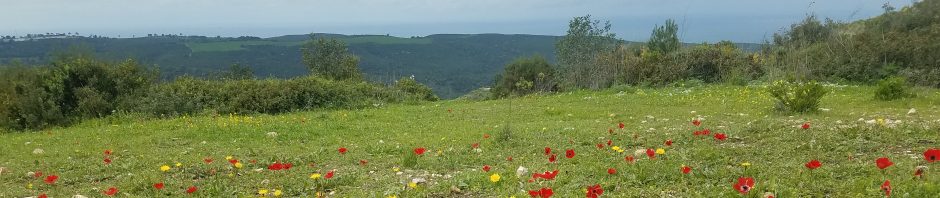
משונה נחלה זו מכל נחלות שבעולם

Lunch time at Yeshivat Maharat. A very pluralistic group of women and men of all ages and Jewish denominations walks into our beit midrash (study). I walk a bit closer and say a very Israeli, “shalom”! They are surprised: “Shalom??” “You look like you’re from the “Eretz Hakodesh” (Holy Land)”, I say in Hebrew, with a big smile. “We are”, they admit, “How did you know?”

It’s hard to explain, though a variation of this happens often. Some connection runs deep, and it travels through the Land. In the daily daf yomi (daily Talmud page) this week we learn: משונה נחלה זו מכל נחלות שבעולם – This Inheritance – i.e. this Land – is unlike any other in the world. How can anyone say it, especially some 1800 years ago? Have they been all over the world?
The torah reading of this week takes it further, with the commandment of shmita, the “sabbatical”. The Land, we’re told, has its own Shabbat. Just like us.
In my endeavor to look at (at least) the first three Books of the Torah as a spiral, rather than just a linear story, I can’t help but notice that each book has a central, somewhat magical, godly, divine place of its own: in Genesis, it’s the Garden of Eden; in Exodus – it’s the mishkan (tabernacle) and in Leviticus –the Land of Israel. If they do spiral, it means each expands on the one meaning that the previous presented. If Genesis is about individuals, Exodus – about Peoplehood and Leviticus – about the practical implications of the earlier ideals in the form of mitzvot, we can say that the Garden – was a heaven for just two people; the mishkan – a place for the whole nation to connect directly with G-d who lives amongst us; and the Land — all that – a heaven and a place to connect with G-d – as well as a place where we can practice all we’ve been taught thus far, and where we can grow.
The group who walked in this morning came through the “Gvanim Program”. I had the honor and pleasure to work with this program during my tenure in San Francisco, and yes I told them that, which began a short game of “where are you from”, “which high school did you go to”, “what did you do in the army”, in hopes to find connections. But what I should have said was, “I knew you as soon as you walked in, because you look like my brothers”.

* * * * * * *

The Shabbat offers us a “double portion” – two Torah readings, closing the Book of Vayikra, Leviticus, before we head to Numbers and Shavuot. The last one includes a list of blessings and fascinating consequences, too scary to read out loud. But I love the opening: אם בחוקותי תלכו…. If you walk in My commandments… (Leviticus 26:3) I like the “if”; I like the “walk”. Angels, says one of the commentators, stand; humans – walk. The 3rd and middle Book of the Torah closes with us on the road. The last words of this Book will be “at Mount Sinai”: we’ve left but have not yet made it to our destination. That is the heart of the Torah. We’re not about arrival, but we’re not staying behind either. We’re all about the journey.

And how do we understand that endless “journeying” coupled with “The” one an only Land? Yes. That’s what happens when you walk with G-d. You encounter contradictions. Or not.

Shabbat Shalom.

Posted in Uncategorized | Tagged , , , , , | 1 Comment

Say What?? Parashat “Emor”

In a Torah portion that gives us a list of all the Biblical holidays, and shares more details regarding the holiness of the priestly service, the last story – in Leviticus 24 – seems completely out of place. A man, son of an Israelite woman and an Egyptian man “goes out” among the Children of Israel, where he and another “Israelite man” have a fight. Is this the only fight to ever take place in the desert? or maybe it happened sometime, when people had nothing much to do?? But this one gets the headlines, because the ”son of the Israelite woman” curses the Name of G-d, and Moses and the people don’t know what to do with him.

י וַיֵּצֵא, בֶּן-אִשָּׁה יִשְׂרְאֵלִית, וְהוּא בֶּן-אִישׁ מִצְרִי, בְּתוֹךְ בְּנֵי יִשְׂרָאֵל; וַיִּנָּצוּ, בַּמַּחֲנֶה, בֶּן הַיִּשְׂרְאֵלִית, וְאִישׁ הַיִּשְׂרְאֵלִי. 10 And the son of an Israelite woman, whose father was an Egyptian, went out among the children of Israel; and the son of the Israelite woman and a man of Israel strove together in the camp.
יא וַיִּקֹּב בֶּן-הָאִשָּׁה הַיִּשְׂרְאֵלִית אֶת-הַשֵּׁם, וַיְקַלֵּל, וַיָּבִיאוּ אֹתוֹ, אֶל-מֹשֶׁה; וְשֵׁם אִמּוֹ שְׁלֹמִית בַּת-דִּבְרִי, לְמַטֵּה-דָן. 11 And the son of the Israelite woman blasphemed the Name, and cursed; and they brought him unto Moses. And his mother’s name was Shelomith, the daughter of Dibri, of the tribe of Dan.
יב וַיַּנִּיחֻהוּ, בַּמִּשְׁמָר, לִפְרֹשׁ לָהֶם, עַל-פִּי יְהוָה 12 And they put him in ward, that it might be declared unto them at the mouth of the LORD. {P}
יג וַיְדַבֵּר יְהוָה, אֶל-מֹשֶׁה לֵּאמֹר. 13 And the LORD spoke unto Moses, saying:
יד הוֹצֵא אֶת-הַמְקַלֵּל, אֶל-מִחוּץ לַמַּחֲנֶה, וְסָמְכוּ כָל-הַשֹּׁמְעִים אֶת-יְדֵיהֶם, עַל-רֹאשׁוֹ; וְרָגְמוּ אֹתוֹ, כָּל-הָעֵדָה. 14 ‘Bring forth him that hath cursed without the camp; and let all that heard him lay their hands upon his head, and let all the congregation stone him.
טו וְאֶל-בְּנֵי יִשְׂרָאֵל, תְּדַבֵּר לֵאמֹר: אִישׁ אִישׁ כִּי-יְקַלֵּל אֱלֹהָיו, וְנָשָׂא חֶטְאוֹ. 15 And thou shalt speak unto the children of Israel, saying: Whosoever curseth his God shall bear his sin.
טז וְנֹקֵב שֵׁם-יְהוָה מוֹת יוּמָת, רָגוֹם יִרְגְּמוּ-בוֹ כָּל-הָעֵדָה: כַּגֵּר, כָּאֶזְרָח–בְּנָקְבוֹ-שֵׁם, יוּמָת… 16 And he that blasphemeth the name of the LORD, he shall surely be put to death; all the congregation shall certainly stone him; as well the stranger, as the home-born, when he blasphemeth the Name, shall be put to death….

A “stand-off” between a “son of an Israelite woman” and “an Israelite man”: One is presumably young; one – mature. One – half member of the community; the other- full. We don’t know the names of those fighting, though we know the mother’s name and the tribe. The story is tragic, for sure, but for a book that is skimpy in details, why tell us about this?

We are a little after the middle of Book of Leviticus, after the mishkan has been prepared and the priests – assigned their jobs. We now have a holy place, holy functions, as well as holy times, as spelled out in the list of holy days in chapter 23. Indeed, everything about Leviticus is about holiness.
If so, the mekalel– the “son” cursing here – might be doing so as a reaction to an extra intensive doze of holiness. For him there is no inspiration. Rather, it is as if he says, ‘enough already, I don’t want it’.
We have seen other reactions to holiness: Nadav & Avihu, Aaron’s son (in chapter 10) got “too close”, their fire caught in G-d’s fire causing their death. We will also see the “mekoshesh”, the man gathering wood on Shabbat, coming up in the Book of Numbers 15:32-33.
If Aaron’s son’s represent the overly ecstatic, the mekoshesh represents someone who is apathetic, who doesn’t know and doesn’t care. One has too much fire, the other – not at all.
In contrast with them, the “curser” in this section represents someone who cares deeply but is irritated with the community and its practices. It’s not that he does not believe in G-d, but rather, he is angry with G-d, the world and rules He created. It’s not that he doesn’t have fire; it’s just all over the place, misplaced. The passage about this man begins with the verb – vayetze, and he went out. Where did he “go out” to? We’re in the desert! He can’t go very far, can he? But he “goes out” – out of himself, of the confined structure of holiness around him. He feels disconnected and lone, facing a fellow Israelite, and especially, facing G-d.
The mekalel did something wrong and deserves to be punished but, he needs to be punished by the “whole community”. Why not just a few judges? Because his behavior, is- partially- everybody’s responsibility. We were told right away that his father was Egyptian. That alone meant that he had no Israelite father to show him ”the ropes” of being Jewish. This “son” did not start out cursing. He started out as a person among many. What happened along the way? Who helped care for him? The community has to take a serious look at itself and do its “cheshbon nefesh”- self introspection. If we were the community, we’d have to ask, where were we when someone grew up among us, alone and isolated? Where were we when a human being, another person created in G-d’s image, was suffering so much that he turned against his fellow and against G-d?
In the last couple of weeks I’ve been watching the Netflix show “13 Reasons Why”. It’s considered “controversial” and “problematic”, and yet, I would still highly recommend it. It’s a show, not a therapy session; it’s designed to make money for Netflix, not to fix anyone’s issues, I get all that. And yet, it raises a similar question regarding the balance between the individual’s responsibility and that of the community around. The short is, we can’t save everybody all the time, but we should at least try. We might be surprised to learn that at times, all it means is noticing someone and greeting them with Shalom.

Shabbat Shalom.

Posted in Uncategorized | Tagged , , , , | Leave a comment

On the Miracle of Pesach Sheni, Second Chances & My Father’s Yahrzeit

Pesach Sheni – literally 2nd Passover – addresses people who missed the 1st Pesach. When it was time to bring the Pascal offering, they were unavailable, either because they were “ritually impure through contact with a dead body, or away on a distant journey” (Numbers 9:1-12). This situation has never come up before, so it is not obvious for Moses what to do. In response to his query, G-d tells him that these people can prepare the same offering a month later, on the next full moon, the 14th of Iyar, this year coming up this Wednesday, May 10.

For many, the day has come to symbolize how “it’s never too late”. If you google it, you’ll find some lovely commentaries: “The eternal significance of the Second Passover’, says the sixth Lubavitcher Rebbe, Rabbi Yosef Yitzchak Schneersohn (1880-1950), ‘is that it’s never too late to rectify a past failing… there is always a Second Passover in which s/he can make good on what s/he has missed out. The Second Passover thus represents the power to go back in time and redefine the past”…
What’s not to love about this teaching. Except that for me, Pesach Sheni happens to be my father’s yahrzeit (the anniversary of his death). And there is nothing like a yahrzeit to remind us that try as we might, there is not “always” a second chance, nor a way to rectify and redefine the past. In fact, the whole teaching seems to highlight exactly the opposite. If there was “always” a second chance, there would not have been a need to ask Moses about it; and there would not have been a need for him to check with G-d Almighty before replying.
What’s more, there is no 2nd any other holiday. If you missed Yom Kippur, that’s just too bad. You can do your own t’shuva (repentance) any day, but that majestic fast day, will only come back next fall. Similarly, if you were incognito during Sukkot or Hanukkah, well, there is going to be another one, but most likely not next month.
So the fact is, the people asking, and Moses himself, knew very well, as I am painfully reminded each year, that second chances are super rare and hard to come by; that while we pray and hope, beg and bargain for them, rather than an “always”, they are usually not readily available and extremely extraordinary.
There is a custom to eat matzah on Pesach Sheni, just like on Passover and some see it as a (very minor) holiday, but for me, it’s a day to light a candle and rummage through old boxes.
I fish out the Berlin newspaper clip from 1928 where my father is featured as a newly discovered young Mozart; The photos of him hiking with his father and brothers – in shorts and a hiking stick; sitting dutifully by his mom, elegant and sharp.

I look at his school portrait from Berlin of the early 1930’s. At 13, he’s properly dressed, hair combed sideways, front row of a non-Jewish school. What did he know about how life is about to change? Just another school day or a forever good bye? Did his parents tell him what’s coming, or did they just do the “German” thing, packing quietly before the journey began?
There are photos from his wedding to my mom, and from their honeymoon – a photographer on the Acropolis catches them climbing up, smiling, looking at each other lovingly; and then with little me on his lap, both of us playing the old piano, a love for music that seeps through the generations on to his grandchildren. I see him with us children at the beautiful Haifa beach: a big colorful beach-ball, the waves playing behind us on the horizon.
And the photos in my head, the moments that no camera ever caught: heading to the synagogue on Friday afternoon, my mom handing him his cane which he reluctantly accepts, while I obliviously skip around in a pretty flowery dress. Hand in hand we walk up the stony steps, deep in conversation, as the sun slowly goes down. Did he already know how numbered were his days?
I find diplomas from his learning and try to piece it together: will I ever find out if he actually went to London for his matriculation, law and accounting exams in the early 1940’s, or did the British Mandate allow for exams in pre-Israel Palestine? There is his photo in the long dark robe: young, proud, successful, a big promise, a big smile, the whole world awaiting; a world full of 1st and 2nd chances.
And there is an envelope my mom saved from the last weeks of his life, no longer able to speak as his body gives in to the horrors of ALS; thin rice paper, almost etched through, with his now shaky, block-lettered handwriting, reverting back to his childhood German: Get the family. Now. Please don’t go.
My brother and I are both older now than he’ll ever be but forever he remains our father and we, his children, with the lessons he’s left behind. It’s Pesach Sheni, and yet, second chances are practically a miracle.

Posted in Uncategorized | Tagged , , , | 2 Comments

A Vignette, a “Full-Moon” & Trees

Vignettes:
I think I have finally moved to NY… My proof? a phone call with some service (bank? phone? who knows-) who asked for my address: “What city? Can you spell it? State please? Can you spell that?” My patience totally ran out. What’s with these people who can’t understand where is Brunxneyork???

“Full-Moon” – פולמון – is a new Israeli TV show – just the right mix of drama and shtuyot (nosense)in manageable segments of 25 minutes each. The background is a beautiful Thailand beach and the storyline involves a colorful cast of Israelis, each with his or her story, and why they ended up there. For anyone who traveled these region (and even for those who didn’t), there are moments that it could pass as a documentary. And – if you make it to the end of the first season’s 50 episodes (yes, I admit, I did), maybe you’ll discover that it’s not just about lost Israelis, Russian mafia, crazy conspiracies or gorgeous views, but also about friendships, the kind, for some reason, that can be found in Israel. Somehow it seems to fit this week. The show can be found on youtube; no subtitles.

In continuation with last week and our love story with the Land, this week’s Torah portion, loaded with intriguing laws, offers one. So we are commanded (Leviticus 19:23):

וְכִי-תָבֹאוּ אֶל-הָאָרֶץ, וּנְטַעְתֶּם כָּל-עֵץ מַאֲכָל… 23 And when ye shall come into the land, and shall have planted all manner of trees for food…

This verse – partially – might be familiar from Jewish National Fund (Keren Kayemet LeYisrael) publications. In this week’s Parashat Kedoshim, it is part of a number of agricultural mitzvot. We are commanded against different kinds of mixing: not to tether mismatched animals together; not to wear wool and linen, and not to sow a field with an inappropriate mixture of seeds (kil’ayim).
As explained here elsewhere, Rabbi Hirsch connects the idea of kil’ayim with the Hebrew word ke-le – prison, since the wrong kind of mixing confines and blocks growth.
In this particular case, we might further derive from this that it is better to not plant at all, so we will not come to mix anything. That’s when the Torah says: “When you come to the Land, you WILL plant”.
In the spirit of spiraling Torah learning, the midrash in Vayikra Rabba 25:3 picks up on the word “etz”, tree, here, and connects us to the first tree and the first planting act in the Torah, back in Genesis:

רַבִּי יְהוּדָה בֶּן רַבִּי סִימוֹן פָּתַח (דברים יג, ה) אַחֲרֵי ה’ אֱלֹהֵיכֶם תֵּלֵכוּ. וְכִי אֶפְשָׁר לְבָשָׂר וָדָם לַהֲלֹךְ אַחַר הַקָּדוֹשׁ בָּרוּךְ הוּא? …וְאַתָּה אוֹמֵר וּבוֹ תִדְבָּקוּן! אֶלָּא מִתְּחִלַּת בְּרִיָּתוֹ שֶׁל עוֹלָם לֹא נִתְעַסֵּק הַקָּדוֹשׁ בָּרוּךְ הוּא אֶלָּא בְּמַטָּע תְּחִלָּה, הֲדָא הוּא דִכְתִיב (בראשית ב, ח): “וַיִּטַּע ה’ אֱלֹהִים גַּן בְּעֵדֶן”, אַף אַתֶּם כְּשֶׁנִכְנָסִין לָאָרֶץ לֹא תִתְעַסְּקוּ אֶלָּא בְּמַטָּע תְּחִלָּה, הֲדָא הוּא דִכְתִיב: כִּי תָבֹאוּ אֶל הָאָרֶץ וּנְטַעְתֶּם.

Rabbi Yochanan ben Shimon began, “‘After the Lord your God shall you walk’ (Deuteronomy 12:5). But is it possible for a human of flesh and blood to walk after the Holy One, blessed be He?… And you say, ‘And (not only you should walk after Him but also) to Him shall you cling?’ But rather, the Holy One, blessed be He, from the very beginning of the creation of the world, occupied Himself with planting first. Hence it is written (Genesis 2:8), ‘And the Lord God planted a garden in Eden.’ You also, when you enter into the land, only occupy yourselves with plantation first. Hence it is written, ‘When you shall come to the land.”

We are told that Rav Kook was invited to participate in a festive tree planting. Everything was prepared in advance, to show respect to the great chief rabbi: the sapling was in plastic wrap, there was a new shovel, the hole already dug in the ground. But Rav Kook instead, set the shovel aside and started digging by hand, kissing each clump of dirt. For our sages of old, likewise, planting trees in the Land of Israel was not only a nice, environmental thing to do, but directly connected to being in G-d’s image and following in His footsteps.

Shabbat Shalom.

Posted in shabbat shalom | Tagged , , , , , , | 1 Comment

Yom Hazikaron: Remembering – במותם ציוו לנו את החיים

As kids we were taught early on to give up our seat on public bus for an older person, but, as the story goes, when my brother, about four or five years old at the time, was told to get up, he responded: “I don’t want to get up for the old lady (mind you, she was probably about my age now –), but I will”, he continued proudly, “for the soldier over there”.
Growing up in Israel, soldiers were like gods, with their sharp uniforms, special shoes and barrette, unit emblems and all. Each one of them better looking than the other; they are all tall, charming, handsome, bright. As a child, you learn to look up to them with awe; you know they do “what they must” and at any moment, might be called to give the “ultimate sacrifice”, just so you can have a state and a safe home. You’re taught the verse “bemotam tzivu lanu et hachayim” – ‘dying, they commanded life to us’, and soon, though you don’t quite understand it, you hear it – and maybe even have the honor to recite it – especially on Yom Hazikaron, Memorial Day, when you stand respectfully, dressed in a white collared shirts and dark bottoms, to read mournful, heartbreaking stories, under the watchful eye of your teacher, her eyes hidden behind thick sunglasses.
It sucks that they have to die, but you’re ten or twelve, and they are giants of 18, 19 and 20, and you think, so it goes. Then you become 20, 21 and 22, and the name in the dark frame is your friend, your classmate, the guy you dance with, joke with, thought you’d have forever with to chat again at a street corner of your neighborhood; and you meet his parents, who turned ancient over night, at the cemetery gate and shiv’a calls; and you and your friends hug each other and cry together, and you think you’re all adults and so very grown-up, and this is “the price we all must pay”, and so it goes and so it must go-on.
And then one day, all of a sudden, you are your teacher; the one who came to school on Yom Hazikaron in her dark sunglasses so no one will see her red eyes; the one who asked the students to read the heart wrenching poetry so no one will hear her broken voice. You look back at your friend’s faded photos and it just hits you; and you realize that those mighty soldiers are just kids; and you’re tired of tragedies and pain, and poignant stories and touching poetry; and you know this is not how it goes; this it not how it has to go; and your heart doubly breaks, for the loss itself and for its continuation; and for the first time you stop and wonder, if maybe, after all, when they commanded us life, didn’t they also ask us to at least make a better effort in finding another way.

** Reporsting from 2016.

Posted in Uncategorized | 4 Comments

Everywhere I go… * …לכל מקום שאני הולך

Long ago (and far away, as it turns out), when I was teaching 4th grade, we got into some amazingly deep conversations. One of them was about the Jewish People and the Land of Israel.

We talked about how this land was described in Torah times as “land of milk and honey” (Exodus 3:8), and yet, when the settlers of the late 19th century arrived, they found mostly swamps and robbers. Mark twain, who traveled the land in 1867, writes a sorrowful description in his book “The Innocent Abroad or the New Pilgrim’s Progress”. He tells of the endless rocky terrain, the rarity of agricultural growth, the painful blasting sun which “almost fried us”, coupled with the lack of shade as well as absence of trees and clean water. A traveler, he shares, can never find both (shelter and water) in the same place: “We traversed some miles of desolate country whose soil is rich enough but is given wholly to weeds – a silent mournful expanse… even the olive tree and the cactus, those fast friends of a worthless soil, had almost deserted the country… Jerusalem is mournful, dreary and lifeless… (it) is hopeless, heartbroken… desolate and unlovely. And why should it be otherwise?”…

Another traveler, Alfon de Lamartine, in his “Recollections of the East” from 1845, adds: “…Outside the walls of Jerusalem, however, we saw no living voice. We encountered that desolation and that deadly silence which we would expect to find at the ruins of Pompei… the burial ground of an entire people…”

Nachmonides of the 12th century writes of his visit to the Holy Land. Though it took place centuries earlier, it’s pretty much the same: “What shall I tell you about the land? There are so many forsaken places and the desolation is great. It comes down to this: the more sacred the place, the more it has suffered – Jerusalem is the most desolate”…

And yet, that was not always the case. Josephus, in his noted “the Jewish Wars”, from around the 1st century, shares a completely different scene: “… For the whole area is excellent for crops or pasture and rich in trees of every kind… it is thickly covered with towns and thanks to the natural abundance of the soil, the many villages are so densely populated….”

Botanists and researchers agree with Josephus and confirm that up until about 1800 years ago, there were forests in the Galilee. Indeed, while the exact interpretation of “milk and honey” is debated – was it, as we’re told in the Babylonian Talmud (Ktubot 111:2), about Rami bar Yechezkel who chanced to Bnai Brak and saw goats grazing under fig trees, so that the honey dripping from the figs mixed with the mild dripping from the goats, hence “Land of milk and honey”?- still, what happened between Exodus 3:8 and Mark Twain?? Was there a sudden disaster, the kind of Pompei??

We’re often told that for centuries, after the Temple was destroyed (70CE), other rulers and settlers passed through the land, using it for their own needs without much care for its tomorrow, depleting its resources. This is how it’s often explained and yet, does this make sense? Was California, for example, of 150 years ago, less beautiful then today? Some might even argue that it’s the reverse! So what is it about the Land of Israel?

Rabbi Yoel Moshe Solomon, one of Petach Tikva’s first settlers in 1878, gives us a hint: “… In all the days passed, from the time her sons left her, she had covered herself with sack cloth, shed tears and withdrew her light and hid in haze… she did not give her strength to strangers not her produce to aliens. Like her son’s destiny, who cannot find rest among the nations, so is hers…”

The land for him is not merely “dirt” in a coincidental geographical spot, but rather, a living woman, pained and bereaved over her missing beloved. As such, she can’t “grow” anything. She does not give herself to anyone else, until her one and only comes back. This sentiment repeats in other writings as well.

We didn’t go into quite this much depth, back in 4th grade, but the idea of this unusual connection, between a People and a Land, slowly became clear. That’s when one of my students raised his hand: “Is that why there’s trouble there now, because the Land is still in pain, over us not being with her? Should we go??”

Rabbi Nachman coined my favorite saying: לכל מקום שאני הולך,אני הולך לארץ ישראל Everywhere I go, I go to the Land of Israel.

The Land gives our meandering journey in this world a purpose and direction. Of course, it’s a metaphor! Or is it?? Yes. The place at our core is a place where the explainable and that which is not – meet; where heavens and earth – kiss. Sometimes we miss it, and how we are able to participate in it, is a personal quest, but at least one day a year we can pause to realize – and to celebrate – how lucky we are to live at a time when we can witness its renewed awakening; the beginning of its redemption.

Happy Yom Ha’atzmaut (Israel’s 69th Independence Day – this coming Tuesday) & Shabbat Shalom.


Posted in Uncategorized | Tagged , , , , | 3 Comments

The Extra 8th Day

A beautiful spring has sprung all over Riverdale. The “sticks” near the river are growing soft, velvety green covering, while flowering trees bloom with intense colors. It’s all so beautiful that I can’t remember: was there a winter here? ever?

*******

Az yashir Moshe… so begins the Song of the Sea, read just earlier this week, on the 7th day of Passover. Az yashir…

Shortly after the Torah reading that day, Rav Avi Weiss got up to be the chazzan for musaf prayer. Aside from being the founder of the Hebrew Institute of Riverdale, nick-named the Bayit, Yeshivat Chovevei and Maharat, he is the kind of person who has a presence. He’s tall. And has a good voice. Top that with the fact that it was the last day of Pesach and most everybody who was away, got back. Shul was pretty full when Rav Avi got up to be chazzan. He started the usual tune, and then, when he got to Kdusha, the central part, switched.

All of a sudden, Kdusha was sung to the Partisan Hymn: the words were of the holiday prayer, but the sub-text thumped in the ears with, “Do not say this is my final way”. Then, just when we figured out what’s going on, he switched again. This time to “Jerusalem of Gold”. Again, the usual prayer continued undisturbed, but underneath it, we were traveling up among pine trees and fresh air, through the Judean hills to the holy city with the hopes of long ago… There is often a reason to come to shul with a tissue. There definitely was at least one on that morning. Az yashir…

Most English versions conveniently translate “az yashir” to mean – “then Moshe sang”, but if so, that should have been  “az Moshe SHAR”. Strangely, the verb here is in the future tense: some day, in the time yet to come, Moses WILL sing. When is this day then? Rav Hirsch teaches that the word “az”, then, shares its root with chaza –to hold as a vision; while some point out that the word as – in gymatria (numerical value) is 8, as in the “8th day”.

“Eight Days a Week”, sang the Beatles… What is it about the number 8? What’s so special about the 8th day? When is it? Anything we’re supposed to do on it??

If you’re in the area, join me this Shabbat at Beth Jacob Oakland (yes, CA!) as we explore this a little further.

Shabbat Slalom.

Posted in Uncategorized | 1 Comment

The Hidden Middle of the Torah and Pesach as a love Song

Vignette:
The most commonly heard words in Riverdale this week before Pesach: “We’re going to Israel!” And my most used word? “OMG!!” because after all the snow and ice, I saw a flower, and that means, there is hope.

On my tea cup, there’s one of Albert Einstein’s famous quotes: “There are two ways to live life: one, as if nothing is a miracle; the other, as if everything is a miracle”. In this week’s Torah portion we come to the middle of the Torah, and though, as we’ll see, there are different ways to figure out the middle, I think they highly recommend Einstein’s second option.
The middle verse includes the “Urim & Tumim” (Leviticus 8:8), the magical stones of the High Priest that received messages from G-d. In many Bibles, there is not even an effort to translate these terms. The middle word is “yesod” (ibid, 8:15), which literally means – foundation, but if we break it apart, can become “ye (G-d) sod (secret)”, while the middle letter is an alef (ibid 8:28), and alef – is G-d’s letter: equal to number 1 and on its own (without added vowels) – silent.
The Torah spells for us just about anything, what we should do and say and eat and learn and much more from day break to night, and yet, in the heart of the readings of this season, when we encounter the most detailed laws, asks us to remember the hidden and miraculous in life.

Passing Over, Hopping and Skipping
The Hebrew word “aviv”, spring, sounds almost the same as “be’ahava”, with love, and is identical in its gymatria. Just a coincidence?
We might never know. It’s up to us to choose what we want to see. That too, is what Pesach is all about, and that too, is love.
Among the Five Megillot (scrolls) in the TaNaCh, Shir Hashirim – Song of Songs – is the one we read on this holiday. It was Rabbi Akiva who famously insisted: “the whole world is only worthy as the day the Song of Songs was given to the People of Israel; for while all the writings are holy, the Song of Songs is the holy of hollies” (Mishna Yadayim, 3:5).
Shir Hashirim is passionate, poetic, and full of colorful imagery (a belly like a “heap of wheat”?), but perhaps what is most striking are the intense details. There is no “he’s a good guy”; “she’s a nice person”. No generalizations, but a great attention to every little minutia. The beloved know each others’ every move, every wrinkle, the way he smiles, the way she listens. They can see each other clearly, even from miles apart. They hear each other without words. They share themselves wholeheartedly and are completely attuned.
Love makes it so everything matters. Small things are suddenly a big deal that can make or break a whole day. One kind gesture; one silly word. Everything is magnified; everything is critical; everything has significance.
This is what we do just before Pesach too. We’re looking for every little spec of chametz, every crumb. It all must be burned, for between lovers there is no room for even the littlest secret; nothing separates them. We’re so meticulous! It must be done just right
And then comes Pesach eve, and what do we celebrate? That G-d “passed-over” our homes, that we were taken to freedom and liberation, that we were given another chance.
Through what great merit did we deserve this? Have we done anything great? So we were slaves, big deal! What are we whining about? Other people were slaves, and— remained slaves, at best assimilated into their masters’ nation and disappeared. The fact that we know the “rest of the story” doesn’t mean we can take it for granted. Why are we here? Is there truly anything magnificent we can point to that we have done?
Our sages tell us that there are 50 gates of “tum’a” טומאה, “spiritual impurity” and distance, and that we made it to gate 49. But nevertheless, G-d “passed-over” us. He knew we had sunk deep; He knew we were no longer in our best, but He had another plan for us and He saw our “potential” and our ”light” and the “big picture”.
And that too, is love.
Rashi says that the word “u-fasachti” ופסחתי “and I will pass-over”, means “vechamalti” – וחמלתי “and I have shown compassion”.
Yet the same root – p.s.ch – פ.ס.ח. can also mean lame: someone who is limping is a “pise’ach” פיסח, and therefore, describing situations that incomplete.
So which way is it?
The prep has to be scrupulous. Such is winter: we count rain days, precipitation, temperatures, clothing, supplies. But when spring comes, that’s all gone. The windows are open; heater is off, and we are joyful to see just the smallest blossom. There is no way to “measure” that. We say thank you not because the tiny flower is physically greater than however many months of darkness and cold we had, but because it’s here; because it exists; because it teaches us hope. We “forgive” all the hardship. Our joy and appreciation “skip over” all the previous days.
The Song of Songs, among its incredible details, introduces a loving form of “passing over”, that of the lover’s voice rushing to his beloved, leaping and skipping over any obstacles:
קול דודי הנה זה בא, מדלג על ההרים, מקפץ על הגבעות
Behold! my beloved! behold, he comes, leaping upon the mountains, hopping upon the hills.. (2:8)
It seems like love is both about paying close attention to details, and about skipping over; about daily tedious hard work, and about dancing for joy and not seeing the little spills. The art and challenge is when to apply which. Perhaps figuring that out, is the heart of the journey and exodus from slavery to freedom.

Shabbat Shalom & Chag (Hug) Same’ach!

Posted in Uncategorized | Leave a comment

Vayikrah – Calling Us to Draw Near

Vignettes:
A miracle happened: the sun peaked out for a couple of lovely hours, and soft pinkish-green buds appeared cautiously on a few of the stick-like branches. That’s’ all. I’m happy. There’s hope.

Vayikrah – calling us to draw near:
When one teaches Torah at this season, the Book of Leviticus falls on you heavily. You cringe when you see it coming, wondering, if you can just avoid it and discuss the upcoming holiday of Pesach – there is so much to say! or maybe look back at the mishkan – there was just not enough time for all the details… or just about anything. And yet, many, many years ago, this is exactly where out sages advised us to begin our children’s learning:
“The sacrifices are pure, and the little ones are pure. Let the pure one deal with the pure things” (Psikta D’rav Kahana, 6). A puzzle, to say the least. What did they mean?
In a way, each book of the Torah offers us a new beginning spiraling and building on the previous one: Exodus expands on what Genesis began, taking the story of a few individuals to that of nationhood.
The Book of Leviticus begins with sacrifices: what to bring when, how and mostly why. How can that possibly be an expansion on previous texts?
After calling Moses, G-d instructs him: אדם כי יקריב מכם קרבן לה …

“If a person among you would bring near an offering to G-d… shall you bring near your offering” (Leviticus 1:2).
The translation is from the Hirsch Chumash and is critical. It avoids using the simple “sacrifice”, and instead, stays close to the Hebrew, “yakriv” – what would normally be “he will sacrifice”, here is “bring near”. That is because the Hebrew for sacrifice comes from the word to draw near, to be karov.
It also uses the word Adam, a person, a human being, which should immediately take us back to the Garden of Eden. Already there, the midrash tells us something strange: that before the world was even created, tshuva – “repentance” or better – a way to come back – was created. This idea is carried through here, through the word adam. “Adam ki yakriv” – if a person can come near, that means that s/he can also become far. From the beginning the Torah recognizes that pull within us. There are always two voices within us, as if one observing us from within; two “inclinations” – good and bad.
Interestingly, on the day the human is created, the day is sealed with “very good”, not only “good” like every other day. That “very good”, our sages say, is the yetzer hara, the evil inclination. How come “very good” is also bad??
We find elsewhere:
שאילו לא היה יצר הרע לא בנה אדם בית ולא נשא אשה ולא הוליד בנים,
Without the yetzer hara, one would not build a home, nor marry a woman nor beget children” (midrash raba on Kohelet). Wait… so is the “evil inclination” good or bad??
Yes.
Because sometimes the same thing can used for good or bad, and both are within us. When we wish to draw near to G-d, we can’t leave half of us behind; we need both parts. Just like the first human, we can’t hide among the trees. We have to come wholeheartedly.
There is another strange thing about the word Adam. Unlike other words for “man”, “woman”, “dude”, “lady”… Adam has no plural. There is only one; that one is each one of us, each unique, each a whole world. The book that will teach us “love your neighbor as yourself” (19:19) starts with a reminder: Our task is to collect our whole self, all the pieces, and with that whole world, come near G-d.
Shabbat Shalom.


Posted in shabbat shalom | Leave a comment

Building a Home and more

Vignettes:
First day of spring in NY: The used-to-be white remnants of last week’s big storm are still lingering around. In spite of the sun, there are still forgotten patches of snow, and piles of unidentified color ice. I smile. I keep a good attitude. I’m the California Girl that everybody is watching, and I need to show it’s no problem at all… But inside I do wonder, what’s the plan here?? Waiting to see some real spring…

The Mishkan
Construction can be a pain… the endless details… “ma’am, would you like this in light almond or dark egg-shell?” the language of the professionals: “it’s 16 on center”… the precision: “it’s not 8’6” but 6’8”…
The Torah in this week’s portion invites us to the most exciting construction project possible: building a house for G-d. And while we toil with zeal, showing up with all our gold, silver, colorful cloth and what not, we’re also told that G-d has no plans to live in it at all. Rather, if we build it, he will dwell among us. The building is not at all for Him. It is for us.
According to some, this Torah portion tells of the greatest miracle in the Torah – not the Splitting of the Sea, the Plagues, and Mana falling from the heavens…All these are made by G-d and G-d, by definition, can make anything so there’s no challenge there. But – the fact that, for once, we can all get together, bring whatever donations we might have, and follow accurate directions to make the mishkan – that is a miracle.
In the second of this Shabbat’s Torah portions the mishkan is called “mishkan ha’edut” – the Tabernacle of Testimony. What is the testimony for? That G-d has forgiven us after the sin of the Golden Calf. But…wait, right after the Golden Calf, G-d already says to Moses that he’s has forgiven. Moses was even instructed to make the new Tablets. So how is the mishkan a testimony for forgiveness? The Maharal explains that the Tablets are not really making peace between the people and G-d, because they just include more instructions of what we have to do. This is not a partnership but a one-way street: He gives us law and we receive. But the mishkan is about a broader “us”-us that is made of people and G-d – joining in the intimate act of building a home together. It will be a place full of objects that remind us of our close relationship and help us “make up” so if and when we might ever fight, we’ll have a home of peace and love to come back to.

Shabbat Mevarchim, the Shabbat of Blessing, is this Shabbat the Shabbat before the month of Nissan. The month of Pesach is upon us and its frantic preparations are in the air. Once upon a time, the calendar started here, with this Month of Redemption. There are many questions and beautiful ideas about this but today, just one.
The question is asked, how come we begin the year with “redemption”? It should be backwards! Start with slavery and work the whole year to get out. Redemption takes a lot of work, effort and time! It should be the last month of year, the culmination of all our labor! But this is not a regular redemption; it’s a miracle; it’s G-d’s. The Maharal connects the word “chametz” – the fermented, unleavened bread, with “lehachmitz”, to miss out – both things to avoid at all costs. On Pesach everything is rushed. Maybe we are reminded that when something good comes our way, we need to attend to it right away and not lose it.

Shabbat Shalom.

Posted in shabbat shalom | Leave a comment