Snow Storm, Post Purim & Light through Broken Things

Vignettes:
I’m walking up and down the streets, hunting for a parking spot. The sun is shining on what would be a gorgeous day if it wasn’t below freezing and windy. Suddenly, I see a gentleman shoveling snow around his Honda. “Hey, can I please help you and have your spot when you leave?” He barely looks at me; ‘don’t talk to strangers’ and all that seems pretty strong here. I repeat my plea another couple of times before I get a partial, ‘no, that’s alright’… What does that mean?? It’s definitely not, and I need that spot. I grab his second shovel. He looks at me surprised. “It’s my last snow storm”, he says with a sigh, “I’m done with this; moving to Florida. You?” “I came from California six months ago”. “Ha ha ha” he chuckles, my poor shoveling style now making sense… “Come back at 3 o’clock. You’ll have the spot”.
I skip through the white piles and slush. Today, I like my neighborhood.

Post Purim Thoughts
Sunday night, plopped in front of my computer absent-mindedly. Purim is just out and Facebook is full of fun pictures: beautiful, creative costumes; colorful baskets of mishlochei manot; and proud, accomplished groups of all women megillah readings. I look at them with some envy. I wish I had one photo too.
Earlier that day, three of us in my car, heading north. No costumes, no plates of food. We’ll be seriously searched, and can bring in nothing short of an ID. The place will try to scare us and impress us with its formidable décor: a tight gate; twirling barbwire all around; guards; big grey buildings and walls. It’s the 3rd year that Yeshivat Maharat goes to NY State’s maximum security women prison for megillah reading. A few ladies are already waiting for us, decorating the little chapel and setting up goodies, provided by the prison chaplain, for an in-house mishlo’ach manot exchange. Some of them hug us warmly; some eye us with curiosity. We sit down to talk.
“Every year, I read chapter 4, and I love Esther there, all strong and inspiring, committing herself to a higher cause and all. But this year, I read chapter 7 too, and there I find Esther, saying, “if we were sold to slavery I would keep quiet, for it’s not worth bothering the king”, and I wonder, really?? For slavery, she’d be quiet? It’s not bad enough for her to say something? To try and make a difference??”
The rays of sun angled into the very quiet little room. For a moment, no one moves. Then one of the prisoners speaks: “Esther had it in her DNA that slavery is not final; that from slavery we can get out. Death? That’s a different thing. That’s the end! But as long as we’re alive, as long as, as they say, ‘our candle is burning’, you know, there is always hope; we have to believe, there is always hope”.
I look at her with glistening eyes. It’s as Purim and everything is “upside down”: I’m in “Max”, learning about hope from someone who’s dealing with life without parole.

Light through Broken Things
Imagine, the dearest, closest person to you in the whole wide world gives you the absolutely most precious handmade gift for which you’ve been waiting for as long as you can remember. You hold it tight, carrying it carefully back home, still feeling so high from your time together. Then suddenly you see something that aggravates you – maybe a group of kids playing a stupid, noisy game, a traffic jam, anything. You’re really, really upset. In your anger you take that precious gift you just received and smash it to smithereens… wait, what??
Indeed, the story of Moses breaking the Tablets after 40 days with G-d, at the sight of the Golden Calf, gets more puzzling the more often one reads it.
At first, it’s sort of fine: the people did something bad; Moses got upset. The Torah teaches us that he’s not G-d; that we can all make mistakes. Great.
But Moses makes other mistakes and has many expressions of his humanity. Why break the Tablets? In fact, how dare he??!! They were not even really his! G-d Herself gave them to him – for the people! Further: those Tablets were not some cheap pottery, made of disposable material. G-d who can do anything, made them! And — He who knows the future, did He not know what will happen? Or did He?? Isn’t He the one who told Moses that the people have sinned! And He knows Moses! He knows he can get upset! Why didn’t He say, ‘hey, put those thongs aside while you’re dealing with them’?! And should you think G-d is not into such details, how about telling Moses to take off his shoes at the Burning Bush??
So…. Did G-d kind of let it happen? Did He maybe think that breaking the Tablets has benefits? that this is what should happen? If so, what can we possibly learn from this?
The Babylonian Talmud in Bava Batra 14:2, quotes / invents a conversation between G-d and Moses, where G-d tells Moses: יישר כוחך ששיברת – loosely translated as – great job for breaking those Tablets! How so?
The first Tablets were made by G-d; handed down by G-d. Alone. We, who teach about humans as partners with G-d in creating and maintaining the world, about the need for halves – like the shekel- to make a whole, aren’t even a bit surprised that no human had any part in this important endeavor?
The rabbis struggled with this. Through many stories they emphasized that even in the most unlikely places, Hashem partners with us. They wanted us to know that a relationship, any relationship, including that with the Divine (and some would say, especially with the Divine) can’t be established on coercion, and on one-sidedness; that the thunder and lightning were impressive, but did not inspire a spirit of voluntarism and participation (in fact, we’re told, “and the people stood afar”). All that “single handedness”, did not work.
The first set was beautiful but it was not ours. We are pained because they are broken, but simultaneously we also know that we had to choose; we had to grow; we had to act, to come willingly, to make, to learn,  to be vulnerable, to love. We had to work at it. Therefore, we had to break. Only then Moses, as the leader and representative, could carve a new set: “פסל לך”, says Hashem, “curve for your own sake…”. Really, if we think about it, we don’t need new Tablets at all. We have the whole Torah scroll. We have the old, broken pieces, and if all else fails, maybe someday we can fix those?
Leonard Cohen teaches us in his song:
Ring the bells that still can ring
Forget your perfect offering
There’s a crack in everything
That’s how the light gets in.
Sometimes, getting something perfect too soon, is too easy. We don’t earn it, don’t appreciate it, can’t live by it. Even the tablets had to be broken to start again. And from that cracked place, start building something real, where heaven and earth can meet, and where the light can get in.

Shabbat Shalom.


Posted in Uncategorized | 4 Comments

Olive Oil for Purim?

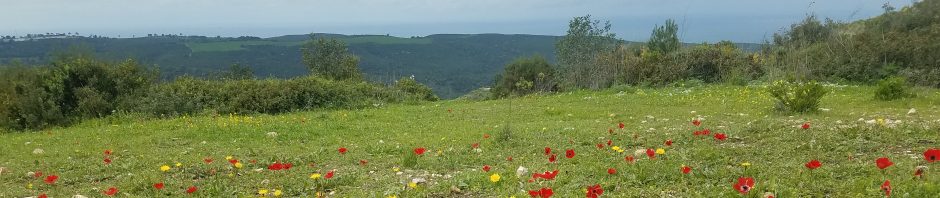
We head out for a quick tiyul (trip) to the Galil. In Israel, spring is springing all around and the hills, to paraphrase John Muir, are calling. Climbing up less traveled, steep roads to gorgeous views among beautiful wildflowers and shades of green trees, this week’s teachings come to life.

The Torah instructs us about olive oil for the menorah, and while we might be satisfied to know that this is simply the oil that was available then and there, our sages of different generations found additional meanings in it, especially since in the Prophets (Jeremiah 11:16) we are compared and named by G-d as a “fresh, beautiful olive”. The Netivot Shalom (1911-2000) comments about this week’s Torah portion of Tetzave, that “an olive is the only fruit that asides from its mere existence as such, hides within it a special power. After it is beaten down and smashed, it reveals a new power stored within it; the power to light a light, grow and sustain a flame. Just like”, continues the rabbi, “our souls, sometimes might need to get “wacked” through life’s “school of hard knocks”, but often, it’s the trials and tribulations that bring out the best in us too, helping us light a bigger light”.

And while we’re on hidden things…

On route back from Israel, I have a stopover in Istanbul. It’s my first time taking Turkish Air and really, so far (:) no complaints. It’s just that, Turkish is a language I don’t even know one word in; the sounds are different as are the written words. It’s very obvious I am very much in “chutz la’aretz” -that’s the way Jews divide the whole world: there are only two parts: a tiny plot of land on the east side of the Mediterranean, and the rest of the globe.

Purim is the only holiday that takes place outside of Israel, and therefore, special celebratory prayers, like Halel (“praise”), are omitted. Wait, ask the rabbis of the Talmud, is this statement really true? What about Pesach, the plagues and the exodus which takes place in Egypt? The Giving of the Torch in the desert? Sukkot about the journey? Well, the orientation of the exodus and everything related, is towards arrival in “The Land”, while Purim begins, ends and remains abroad.

Furthermore, the Purim story is all one big confusion. Things have no rhyme or reason. There is a crazy party for more than 180 days (6 months!!); decrees that are made just because; people rise and fall from power due to the king’s whim, and the king himself is influenced by drinking, beauty, and sweet-talk, rather than good or bad deeds, strategic planning, values etc. Things are happening haphazardly. And, not to minimize in the greatness of hidden miracles, but even those are only “so-so”: we manage to not get killed and are allowed to defend ourselves, but we stay in the diaspora with future disasters just around the corner, and – with a “brown-out” and a disconnect from each other and the Divine. Our identity is not clear: the diaspora Jews of the story are either too quiet and embarrassed by who they are, or too boisterous, “in your face” and get everybody in trouble. There seems to be no way in between, while G-d’s Holy Name is not even mentioned in the whole megilla.

By complete contrast stand these season’s Torah portions, usually read around Pruim– all about the construction of the mishkan, the mobile Temple. The almost obvious connection is the lavish, colorful cloth, as well as gold and silver vessels described in both. The midrash tells us that Achashverosh, the Persian king, and his advisors, calculated that the Jews will not be able to return to their land and therefore, assumed all this wealth, which was taken from the Temple, was his to stay.

But maybe there is something else. Unlike the Purim story, the mishkan is precise and predictable; it’s about order and reason. There is a specific way to hook up the curtains; an exact place for the aron (the Holy Ark) and its poles; a certain way to light the menorah. The mishkan introduces order into the journey. It’s mobile and at the same time, not chaotic but allows for a focused place of worship, atonement, unity, peace and growth.

I am on route west, and my official address has not been in Israel for many years, so I am not writing this to preach. Just to remind, maybe first and foremost myself, that in spite of any difficulties in Israel, there might something very disorienting for us as a people about constantly being away from where we’re supposed to be.

Shabbat Shalom & Happy Purim.


Posted in Uncategorized | 1 Comment

Building a Mishkan, here and now

“It’s especially poignant that we are here today, as this week’s Torah portion talks about the spirit of voluntarism, when it describes our People getting together to build the mishkan”. I’m at an outdoor amphitheater on a breezy Thursday evening as the sun is setting on the Judean Hills. The speaker is one of the IDF’s rabbis. The occasion: the swearing in of new soldiers into the Giv’ati infantry brigade. There are hundreds, maybe thousands of family members, relatives and friends around us, and about 500 soldiers on stage. One of them – you see, the tall, handsome one, in the back row, center stage?? That one is mine.

The tiny moon of early Adar is rising in the west as lights shine on the – still – massive Latrun fortress in back. Latrun is located at a strategic hilltop, just off Israel’s highway 1, overlooking the road between Tel Aviv and Jerusalem, exactly where the road narrows and goes up. It was the site of famous, fierce fighting during 1948, but that was not the first time war took place in this area. Judah Maccabee battled here with the Seleucid Greeks, who had invaded Israel/Judea and were camped nearby. In what is known as the “Battle of Emmaus”, using tactics which led the few to win against the many, he successfully advanced the people to a greater Jewish autonomy over that next century. And before then, Joshua defeated the Amorites (Joshua 10:1–11). Later yet, the Crusaders and Muslims fought over control here, as the need to guard the road to Jerusalem was always key.

But this beautiful area of hills and valleys was not only a place a war. In 1890 a monastery was established at Latrun by French, German and Flemish monks of the Trappists order. Currently nearby, is Mini-Israel. Vineyards and fruit trees of different kinds adorn the slopes all around, between them spring flowers bursting in gorgeous colors.

I love the view here, but this time, am much more involved with what’s happening on the stage. The next speaker now continues and quotes from the TaNaCh (Bible), reading Joshua 1:1: “Be strong and courageous”, said the leader of long ago – repeating these words three time within mere 9 verses, as if we didn’t catch it the first times. The topic then is inheriting the land, and yet the focus is – not letting go of the Torah “day and night” (1:8). As a mark of this “unthinkable contradiction, which only you can hold and can only exist in you”, per Giv’ati’s commander, each soldier is entrusted with his personal gun – and a TaNaCh. The crowd is asked to rise up for Hatikvah, singing in choked voices, watching the sky with glistening eyes. Indeed, we are a people of contradiction and that is who we are.

After it’s all over, the soldiers meet up with their families and friends. It’s all one big happening Israel style – uniforms and civilians; laughs and tears; guns and flowers and balloons. People are picnicking on the lawns around, one family even pulls out a small stove and cooks; others are offering each other pastries, pita, chumus and other goodies. No one is a stranger here tonight. The parking lot is completely jammed but almost no one honks, letting each other go ahead with a smile. There’s a sort of a magic: we’re building a mishkan together, each brining what s/he can volunteer and what s/he can, each according to his heart. The mishkan, might not have purple walls, a mysterious covering and wood beams anymore, no table, ark or golden menorah, but it is real and meaningful as ever. As we turn to leave, the bells of the monastery chime for us an evening prayer for peace.

Shabbat Shalom.


Posted in Uncategorized | 2 Comments

Carrying the Torah’s Progressive Spirit into the Future

Shabbat Shkalim – the Shabbat before Rosh Hodesh Adar, a month which is welcomed with “mishenichnas Adar, marbim besimcha” – משנכנס אדר, מרבין בשמחה – when this month enters, we increase our joy. We read an extra short section about counting people in the desert. How do we count? Everyone should give 1/2 a shekel. Why half and not quarter, tenth or a whole? Maybe the half to remind us that each one of us is only a half without another, especially in order to bring in that extra simcha.

* * * * * * *

Below is my efforts to respond to the recent OU controversy about women’s rabbis from a slightly different angle. My humble hope is to have a conversation from big-picture values and peoplehood future, rather than minutia of halacha. Time will tell. Published today by Yeshivat Maharat.

 red circles top 3

YM final colorJPEG

Pastoral Torah: Existential and Spiritual Insights into the Parsha

By Michal Kohane (’20)

Carrying the Torah’s Progressive Spirit into the Future

Shabbat Mishpatim 2017/5777

 Michal Kohane 

There is only one passage in the Written Law where the Torah discusses a man’s obligations towards his wife, and it can be found in this week’s parasha, Parashat Mishpatim:

אִםאַחֶרֶת, יִקַּחלוֹשְׁאֵרָהּ כְּסוּתָהּ וְעֹנָתָהּ, לֹא יִגְרָע.

10 If he takes unto himself another (wife), her food (she’era), her clothing (k’suta), and her conjugal rights (onata), shall he not diminish (Exodus 21:10).

Just last week, we were at Sinai. The mountain was smoking; the shofar sounded, and we could actually see the voices! Moses brought down the Ten Commandments and we all answered “na’ase venishma” – we will do and we will listen. What an amazing experience! This week, as if in a natural continuation – symbolized by the connecting letter “vav” in its opening, the 18th weekly parasha includes many detailed mitzvot. It begins with the laws of eved ivri – a Hebrew servant, and the verse above describes the obligations towards a female maidservant. The understanding follows that if receiving these, is the right of a maidservant, how much more so is a man obligated towards his wife.

Commentators differ in their translations and insights about the meaning of the three requirements mentioned in the verse:

Onkelos, Rashi and the Rambam understand she’era to be her food and sustenance; k’suta – her clothing, and onata – sexual relations. Ibn Ezra, however, explains that while onata might come from ona – sexual “time”, it can also be derived from ma’on – a dwelling place, thus implying housing, shelter. The Rashbam, Rashi’s grandson, agrees with Ibn Ezra’s reading of “housing” and thinks that the Torah would not have to mention sexual relations because that is “obvious”. Ramban is the most surprising since he thinks that all three have to do with the connectedness between husband and wife: she’era – from she’er basar, close relative; k’suta – hinting at the bedspread, and onata – their relations. Accordingly, there is no need to mention food and clothing as that goes without saying.

I’m always touched by the sages’ lack of shyness as well as openness as they playfully share different personal stories about intimacy. Well known is the following (Babylonian Talmud, Brachot, 62:a):

רב כהנא על גנא תותיה פורייה דרב שמעיה דשח ושחק ועשה צרכיו אמר ליה דמי פומיה דאבא כדלא שריף תבשילא אל כהנא הכא את פוק דלאו אורח ארעא אמר לו תורה היא וללמוד אני צריך

Rav Kahana entered and lay beneath Rav’s bed. He heard Rav chatting and laughing with his wife, and seeing to his needs (having relations with her). Rav Kahana said to Rav: The mouth of Abba, Rav, is like one whom has never eaten a cooked dish (his behavior was lustful). Rav said to him: Kahana, are you here? Get out, as this is an undesirable mode of behavior. Rav Kahana said to him: It is Torah, and I must learn.

But let us not mistake being playful for being lightheaded. The seriousness with which the sages regarded their marital relationships and the treatment of women is striking, especially on the backdrop of the ancient world when society was largely patriarchal, as we’re told in Megilat Esther:

להיות כל איש שורר בביתו

For every man was to be a ruler in his home (Esther 1:22)

At a time and place in history when women’s status was extremely low, the Torah appears as a progressive manuscript, which places restrictions on the husband as a “ruler”. The Talmudic sages just added to those. For example, we find:

האיש נמכר בגנבתו, ואין האשה נמכרת בגנבתה

Man can be sold (to slavery) due to his theft, but the woman is not sold in her theft (Sota 3:8)

 In the case of stoning:

האיש נסקל ערום, ואין האשה נסקלת ערומה

A man is stoned naked, and a woman is not stoned naked (there).

And more.

In all monetary matters, a woman is equal to a man. Our Torah portion which deals with monetary compensation, opens with the words:

ואלה המשפטים אשר תשים לפניהם

These are the laws you shall place in front of them (Exodus 21:1)

The Talmud explains “In front of them” – in front of men and women alike (Talmud, Kidushin 35:1) as it says:

השווה הכתוב בין איש ואשה

Scripture put man and woman on equal footing (literally: “evened out” man and woman).

This is also true regarding capital punishment and all negative (“do not do”) commandments in the Torah. It all comes down to the creation story, when man and woman were created – equally – in G-d’s image:

ויברא אלהים את האדם בצלמו, בצלם אלהים ברא אותו, זכר ונקבה ברא אותם

And G-d created the human in His image; in the image of G-d He created him; male and female He created them (Genesis 1:27).

If anything, the Talmud instructs a man in “a great principle that safeguards the rights of the women of Israel” (19th century Rav Hirsch about Talmud, Ktubot 48a):

עולה עימו ואינה יורדת עימו

She rises to his (higher) status in life but does not fall from hers to match his (if it’s lower).

One additional reminder to the critical presence of a woman’s voice in a man’s life. Here’s G-d’s appearance in Abraham’s tent with His clear instruction to our patriarch (Genesis 21:12):

כֹּל אֲשֶׁר תֹּאמַר אֵלֶיךָ שָׂרָה, שְׁמַע בְּקֹלָהּ

All Sarah says to you, heed her voice.

G-d could have said: in matters of child rearing, home, or any other specific arena, do listen, while in all other areas of life, you’re the “man”, but instead He opted to say – all.  

Thus, the Torah’s ideal expresses a delicate balance and equality between men and women, which could have been maintained for almost 2000 years when the focus of Jewish life was the home; most people did not travel outside of their birth area, and life was contained in the immediate community. This was reflected in volumes and volumes of halacha, largely dealing with the topics of family and neighborly relationships. 

However, the last two hundred years, following the Enlightenment and Emancipation, have seen a major, unprecedented, objective shift outward. We are no longer people of a shtetl, closed by the ghetto’s walls, but that of Facebook and Linkedin, active participants in a big, wide, well-connected world. Globally, perhaps the most visible mark of this new era is the miraculous establishment of the State of Israel. These shifts call on us to draw on our tradition and revive this voice, as we forge a path into the future. 

How do we apply, not only the precise letter of the law, but its spirit as well? How do we continue the journey we began at Sinai, and carry  the Torah’s core values forward, specifically as applied to the Torah’s attitude towards the relationship between man and woman? How do we answer these new questions from a place of trust, respect and love? That is the task at hand.

Shabbat Shalom!  


Michal Kohane is a first year student at Yeshivat Maharat.
Posted in Uncategorized | Leave a comment

On Seeing Voices

Vignettes:
The snow storms have covered up cars, sidewalks, lawns, bushes, rocks and garbage bags in strange formations, but here and there, colorful spots appear on the white carpet. A creative art project and / or anthropological survey can be conducted with the assortment of single gloves in the streets.

The icy, dirty snow in the streets glistens in the bright, freezing sun. It looks so beautiful to take a walk or run, until that first  step into the wind. In the stairwell I come across an older couple huffing and puffing. “It’s our gym”, they apologize with a smile. “mine too”, I agree as I hop on, at least on the way down…

Recently, I attended a couple of “Bar (Bat) Mitzvah Fairs”. The fairs usually take place in a pretty nice hotel’s ballroom, where various vendors set up shop to sell “Bar Mitzvah related items”. What’s “Bar/ Bat Mitzvah related items”? In “my time” / my kids’ time, it would have been different kinds of kippot, maybe an especially stylish bencher. But in a world where, per Jackie Mason, “everybody is Jewish”, Bar Mitzvah Fair has not only the kippa vendors, but also — glitzy dancers, cruises and personalized trips around the world, giant cakes and specialty desserts (dry-ice dyed popcorn to look smoking…), clothing, cards, every sort of swag imaginable (and more), and professional party planners who will do the whole event for you, just show up. Actually, maybe don’t. There is also an option to rent a VR (Virtual Reality) set; transport yourself straight to the Torah reading and be done with it.
I walk away empty, wondering what are we doing and where we’ve gone wrong. Here’s to hoping this life cycle event somehow regains greater meaning.

And while on smoking, in this week’s Torah reading, the mountain itself is smoking when the Children of Israel receive the Law. Commentators differ as to exactly what happened, and what exactly we got, but whatever it was, it changed human history forever.
Because we can’t perceive things without words, it had to be broken down into a list of items: there are ten of them and they can be grouped – in five’s or two’s; we can read them backwards, we can count the letters… each method adds new ideas, significance and depth, while at the same time, also takes away from the totality of it.
The Torah tries to convey the remarkableness of the event by providing a unique description: “and all the people see the voices… וכל העם רואים את הקולות” (Exodus 20:15). How come everybody was able to see? And how can anyone see voices? The description is almost psychotic! Can we really use one sense for another?
Rashi tells us, in the name of an older midrash, that no one was blind, deaf or mute, hence they could see and answer, saying, “na’ase venishma –  נעשה ונשמע” – we will do and we will listen. The midrash itself focuses on the fact that the text did not say that “the people see A voice” in the singular, but rather – voices. Why would the One G-d speak in many voices?? One way to understand it is that just like the manna was one “thing” but once on the ground, could be experienced by each person as a different food and flavor, so too G-d voice, comes to us as voices, each hearing what we’re ready for. Even Moses and Aaron heard different things! In the same “dibur” (saying), Moses heard G-d telling him to go from Midyan back to Egypt, while Aaron heard that he should leave Egypt and go to the desert. That’s how they met: they heard the same voice but to each it had a different instruction which was appropriate to him (Shmot Rabba 5:9).
Rav Hirsch points to the added value in “seeing the voices” as it implies greater confirmation of the speaker, for if I only hear and don’t see, I might not recognize the speaker or know where the sound is coming from. Alternatively, if I only see, the message might be outward and superficial– think phone and soundless tv. The Kli Yakar reminds us that one cannot hear as far as one can see. The People moved away from the grandness of the event, but by seeing the voices, the message stays that much stronger, surer and True. Should someone one day try to challenge it, they would know that the experience was doubly strong. Ibn Ezra tells us that in their essence, all emotions funnel to and stem from one common place within a person, only finding different expressions. The fluidity with which we use our senses might be reflected in modern communication: we say – “I hear you” when we’re writing a text… “I see what you’re saying” when we’re on the phone.
No doubt the experience was too intense. As the People withdrew back, fearing death, they asked Moses to speak for them. Nevertheless, G-d says, “so you will tell the Children of Israel, you saw that I spoke with you from the heaven”… (Exodus 20:19).
The voices we saw at Sinai seeped into the world and history changed forever. No longer a few individuals who hear G-d’s calls, but a whole nation transformed, as we witnessed a glimpse of the Divide. Faced with that which is beyond comprehension, if anything, the fact that we don’t know exactly what happened and need so many commentators to explain just a few words of it, might show us how Divine it was.

Shabbat Shalom.


Posted in Uncategorized | Tagged , , , | Leave a comment

On Trees, Water and Trust

Due to my Ashkenazi heritage, I have nothing to eat on Pesach and am inundated with all sorts of “chumrot” (strictures), but I am thankful for a beautiful tradition– the celebration of Tu Bishvat.
It’s a bit ironic to write about Tu Bishvat when there’s a major snow storm outside (finally!), but also so appropriate. For while Tu Bishvat is all Israel – just walk out among the blooming almond trees and breathe and it’s right there – in the diaspora, especially in the snowy, cold diaspora, that’s a whole different story.
The first thing the Ashkenazi community could do to mark Tu Bishvat was to declare it a non-fast day (got to start somewhere…). Later they added dried fruits, not as a treat, but because there was nothing else that was edible in the winter months from the Holy Land. In the 17th century, the kabalists add the Tu Bishvat seder which has become more and more prevalent in recent decades.
So much so that this past Sunday, I had the honor and pleasure to co-lead a Tu Bishvat seder as part of my internship at New York’s maximum security women prison. It’s always eerie: to pass the guards, towers, check ups…I feel a multi-generational PTSD… But once inside, in the prison’s “Jewish chapel”, it’s a different story. For just a couple of hours, the small room is transposed: the table covered and laden with grape juice, both red and white, as well as bowls of various dried fruits and nuts. We chat and learn together; we discuss what kind of fruit we might be – shell on the outside or pit inside? My co-leader and I even manage a halachik argument: should we say a blessing over each cup or just once? We could have been anywhere: a group of women munching on goodies, casually talking about life, coloring pictures of trees to decorate the thick concrete walls around with our art. When it’s time to say good bye, we hug affectionately till our next meeting. If Tu Bishvat ever meant to be a reminder of warmth, life and hope in cold places, celebrating it in prison must be best.
*******
It’s the week following the OU statement about women leadership in the Orthodox community; and now, the week of “nevertheless”. It’s also the bar mitzvah of my daughter’s bat mitzvah (don’t do the math-), when there were still three generations of women alive in our family, celebrating together. Most of all, it’s Shabbat Shira – the songs of Miriam and Dvora, the first – by the shores of the sea, the latter – under a palm tree.
Miriam and water go together, from the time she was a little girl watching her brother from the bulrushes by the bank of the river, to the loss of the well with her death, later in the Book of Numbers, through her song this week.
To be sure, the song started out with Moses and the people, expressing their joy and thankfulness, but it wasn’t complete until Miriam and the women joined in. There are numerous fun, sexy if I may, lively midrashim, regarding the women in Egypt, who, throughout the years of slavery, were the ones who pushed for surviving and thriving against all odds. There was no way to limit their creativity and ingenuity, and in many ways, though the background is very different, not much has changed since. The song is just one of those moments when it’s obvious, that only when everybody gets together, allowing each to blossom in their own way, the celebration is complete.
*******
How to turn a band of slaves into a nation? There is lots to do. They need a calendar so they can be synchronized, which we started last week. They need to be safe. They need food. They need water. They need direction. They need rest… In the middle of trying to get all this together, suddenly they long to go back… Growing up is a challenging journey.
One of the first skills they must acquire is learning to trust. Moses tries to explain. This is not the time for long teachings, and he does get rebuked for it, but what he says is beautiful:
“”ויאמר משה אל העם אל תיראו, התיצבו וראו את ישועת ה’ אשר יעשה לכם היום… ה’ ילחם לכם ואתם תחרישון
“And Moses said to the people, do not fear, stand up and see G-d’s salvation which will be done to you today… Hashem will fight for you and you’ll be silent” (Exodus 14:14). This is the easy translation, but what if we stretch the words?
“Fight” in Hebrew – yilachem – shares its root with bread – lechem, as in struggle for basic sustenance; tacharishun – can mean, be still, but it can also mean “you will plow”: (lehacharish – be quiet; lacharosh – to sow), perhaps sharing a form of purposeful, quiet participation and attentiveness.
If so, this same verse can be read: ‘Hashem will give you bread, and you will plow’. In the desert, water comes from the ground (in the form of traveling wells), and bread – rains from the heavens (in the form of manna). Life is magical and contrary to the natural order of things. In “real life”, you’ll enter a new partnership, not that of slavery. You no longer work for nothing, nor do you work for a foreign king’s gain. Your future partnership is with G-d: you work, so Hashem can give you your sustenance. What do we need to do to allow this to happen?
The manna which also appears this week is another exercise in trust: It comes down every day in exactly the right amount needed, except on Shabbat when a double portion comes down on Friday. What’s it like to go to sleep with nothing yet know that all our needs will met tomorrow? For us, maybe the taste of that peace and trust is the gift of Shabbat.

Shabbat Shalom!

שקדיה ושלגיה

Posted in Uncategorized | Leave a comment

These & These are my Brothers

Vignettes:
Not long ago, I would watch “House of Cards” and wonder if I’m in the middle of a news report. Now I watch the news and can only hope I am in the middle of a crazy Netflix show that has gone terribly wrong…

This week’s images from Israel reminded many of Yamit. And Gush Katif. But just because something looks the same, does not mean it is exactly the same. What’s the difference?
In the past, we spoke about security concerns; once, we even got peace. But now it’s because we, the people who brought to the world the belief in the One G-d, the Torah and (amazing!) Talmud, the basis for civil law in the modern world; who created a miraculous “homeland”, who sent airplanes and secret missions to save people in heroic operations; who survived against all odds for thousands of years and are called to be a light unto the nations – can’t figure out how to peacefully rearrange a few plots of land with minimum harm to those involved.
And still, not maximizing on the best solution, would be the least of it. For while some are pained and torn, trying to pack 18 years into a suitcase, others are cheering against them, joyful at those hurting.
Amona is not the issue, but it does serve as a mirror to how far we’ve gone. To paraphrase Yehuda Amichai, redemption will come only when we can shift our viewpoint, and begin to see each other.

And while we’re on seeing:
This week we encounter the three last plagues, and among them – the plague of darkness. Some say, it was a darkness that had thickness. But some say, it was not too dark to see, just too dark to recognize one another. And yet, the midrash tells us, that in some places, there was light. What was that light? The Torah. How so? Not as a religious coercion and an oppressive list of do’s and don’t’s but as an expansive way of life that invites us to step out of ourselves and care for another; a way of light, Torah-Or.
*******
Ten whole Plagues. Days, weeks and months of preparations, including even time to collect gold and silver vessels. And suddenly, chipazon!! A great and almost frantic rush. Get out! Get out! Never mind the dough! Just go!
What’s going on?
The Exodus was not a surprise. We knew it was coming. There was a “process”. After years of slavery, we had to slowly be reminded that there is a tomorrow; learn that there is hope; that things can actually get better, that we matter, all things that, as slaves, we could not even imagine. That build up was necessary, and had to be gradual, just like when picking up anyone out of any bad situation…
But then one day, it’s time to go. And go we must in chipazon – חיפזון.
Rabbi Hirsch says the root ch.p.z. ח.פ.ז. means – hasten aimlessly. Aimlessly?? Aren’t we going to freedom??
We’re going, that’s for sure. We don’t yet know where to. G-d says to Moses, to a land of milk and honey. Moses says to Pharaoh, it’s just a quick trip to celebrate a festival. The experience of the people must be super confusing. Strange things happen all around: the river turns to blood, frogs everywhere, lice, animals… It’s no wonder there is “darkness”.
But then comes a day…
The battered woman who prepared her get-away carefully, waiting for that once in a lifetime window of opportunity, now must act; Our kidnapped soldier from Chatufim who couldn’t even dream that it’s possible, is now being whisked out secretly with no time for goodbyes to his captives (with whom he’s gotten close!); And the Children of Israel, who “all of a sudden” are in such a hurry that they can’t finish making sandwiches for the trip.
The two Torah portions – of patience and haste – go hand in hand. There is time for the lengthy prep, but then comes the time to just get up and go.
*******
With the Exodus, we receive the first mitzvah as a people: creating a calendar by setting the new moon and keeping track of time. And the question comes up again: if the Torah is all about doing mitzvoth, why not start right here? Why drag us all the way back to Genesis, the creation of the world etc? Who cares? Maybe because the Torah is not the constitution, and not a dry list of laws, but so much more.

Shabbat Shalom.

These & these are my brothers

Posted in Uncategorized | Tagged , , , , , | Leave a comment

Savlanut, Savlanut…

Vignettes:

  • I’m waiting for that real winter I’ve heard so much about… But this year, it seems that if I want winter, I should move to California. Or Jerusalem.
  • Some days the best thing that happens is losing a wallet, going totally crazy, and then finding it again, 5 hours later, resting peacefully 5 feet from where it was lost…
  • I have no idea how old I am. I mean, I can count, but since I have never been here before and have little reference, I am not exactly sure what that means. Then, I rush into the subway all frazzled, and some young guy asks if I want to sit… first thought: ouch, that hurts; why is he offering me a seat? aren’t we the same age?? Then, looking around the crowded subway situation: thank you wrinkles and some grey!
  • My yeshiva joy is daf yomi, the daily learning of one (double) page of Talmud. And this week: starting Bava Batra and a story about our complex relationship with a foreign government, inside a special focus on who’s to pay if one neighbor wants to build a wall, and the other one – doesn’t. Can the neighbor who doesn’t want the fence / wall be forced to pay?? and if yes, why? and how much? half? whole? nothing? Well, you know, the Talmud; a very ancient document about all sorts of irrelevant details; glad there’s nothing current…

Torah: I have the honor to have been this week’s yeshivat Maharat’s parasha writer. Below is what went out.red circles top 3

YM final colorJPEG

Pastoral Torah: Existential and Spiritual Insights into the Parsha

By Michal Kohane (’20)

Michal Kohane

Savlanut! Undoing the Web of Enslavement
Shabbat Va’era  2017/5777

 בעשרה מאמרות נברא העולם

“The world was created through Ten Utterances, our sages tell us” (Pirkei Avot 5:1). And yet, one wonders: The same God Almighty who can create a perfect world in 10 sayings, could do so in one! Why the extra work then? Let’s hold the question while we look at this week’s Torah portion.

The journey of a band of slaves becoming a free people, is fascinating, perhaps because it’s something that each person can identify with on many levels. Whether the story of one’s birth, or our struggle with various kinds of mitzrayim – narrow places – of enslavement (physical, emotional, spiritual) and our complicated journey to freedom.

Once again, we read this week, about the first seven of the Ten Plagues, reminiscent of the Ten Utterances as well as the later Ten Commandments; and once again we may wonder, why so many plagues? If G-d – or anyone for that matter- wants to get someone out of a bad situation, why not just go in and get them out? And the people? Didn’t they know they were suffering in slavery? Didn’t they groan and moan, crying and wanting to get out??

Rashi, the medieval commentator, points to Exodus 6:9:

  וְלֹא שָׁמְעוּ אֶלמשֶׁה מִקֹּצֶר רוּחַ וּמֵעֲבֹדָה קָשָׁה – “and they did not listen unto Moses due to impatience of spirit, and cruel bondage”. Drawing on the unique term “kotzer ru’ach” – literally meaning, shortness of breath, he says that someone whose breath (“ru’ach”, also wind, spirit, soul) is short, cannot have long breathing. Isn’t Rashi stating the obvious?

Rabbi Binyamin Lau explains Rashi: “This is like a person who is experiencing an asthma attack, and seeks immediate relief. As he reaches for his inhaler, someone tells them about an experimental new drug which might be available someday. The patient’s reaction is likely to be – I’m choking here, and you’re talking to me about something long term in the future? Likewise, the rulers of Egypt were pressuring the Children of Israel, leaving them breathless, unable to hear anything”.

Next, G-d explains to Moses the famous stages to the delivery from bondage, using the ארבע לשונות גאולה:  Four Expressions of Salvation:

 והוצאתיוהיצלתיוגאלתיולקחתי…  “and I shall take you out…. And I shall save you…. and I shall redeem you… and I shall take you to me unto a nation” (Exodus 6:6-8), which are the basis for our Four Cups on Passover. And again, we wonder. We can easily understand the asthma patient metaphor, but here we’re talking about G-d! Why not just get the people out already? After all, they were in so much anguish and G-d can do anything!

Inspired by watching “Chatufim”, the Israeli TV drama that was bought in the U.S. and became Homeland, I realized the devastating pattern of enslavement.

Chatufim tells the story of three IDF soldiers who are kidnapped and kept in captivity for 17 years. The complex and highly recommended show, takes a serious look into the psychology of the kidnapped. It shows what happens to someone who is kept in isolation, beaten up (physically and emotionally) and yet, at the same time, cared for and fed. Each one of these three components is critical to the combination, and creates a complete dependency of the kidnapped to his capturers.

This pattern repeats itself in all abuse situations, from that of POW’s, to battered women, to the Children of Israel in Egypt. We’ll see it later, when the Children of Israel will “remember the fish, which we ate in Egypt for free; the cucumbers, and the melons, and the leeks, and the onions, and the garlic” (Number 11:5). Is their imagination running wild? Are they suffering from heat stroke? Or perhaps, not everything was bad in Egypt, or else slavery would not have been possible. Too much oppression ultimately begets escape, riots and revolts, or the death of captive, situations the oppressor usually want to avoid. It takes the right mixture of isolation (in this case away from their land, from the silent G-d), harsh labor and torture (as in the back breaking work and killing of the baby boys,) as well as care (“free food” and a sense of safety) to create the ultimate slavery.

When we see people in abuse situation, we often wonder: why doesn’t this person who is in so much pain, just walk out? If living in Egypt didn’t work anymore, why didn’t Jacob’s children travel the relatively short distance home, with the many caravans and merchants who passed by? Similarly, why didn’t the Jews of the 1930’s leave Europe? Why doesn’t the battered woman walk out on her abuser? Why doesn’t our hero in Chatufim cross the border, not even a few kilometers away, even though there are times he can? Why don’t we free ourselves from what’s holding us down internally?

Because from where we stand during these moments, it’s not possible. The successful captor knows it. The successful redeemer must know it too. The carefully constructed web designed to keep one in, must be carefully undone to ensure a complete and safe journey out. Hayim Sabato in his book “Ahavat Torah” points out that the “Four Expressions of Salvation”, G-d’s plan which He shares with Moses, appear in three verses. Which correspond to the three elements that hold one in, and parallel the three elements needed in the Jewish People’s redemption: The Exodus, the Covenant at Sinai, and the journey to the Land of Israel. These further parallel to the three “regalim”, our holidays that celebrate that journey, Pesach, Shavuot and Sukkot. The journey takes a detailed plan in order  to be successful. Likewise, when encountering enslavement, from within or without, maybe we shouldn’t judge too quickly. Even G-d takes time when delivering a band of slaves from their oppressor. We too, have to be patient with the journey ahead.

Shabbat Shalom & Hodesh Tov!


Posted in Uncategorized | 2 Comments

The Power of a Genuine Smile

Raising children in the 1990’s and early 2000, meant that “Prince of Egypt” played repeatedly on our little then TV-VCR. Aside from its grand success in our home, the film went on to gross over $218 million worldwide in theaters, which made it the most successful non-Disney animated feature at the time. The song, “Deliver Us”, sung by the late Ofra Haza, was translated to 17 languages and (the song) “When You Believe” won Best Original Song at the 1999 Academy Awards. The creators of the film took the liberty to offer a modern midrash to the ancient story, and yet, they didn’t do without insight into the sources.
A couple of scenes are especially interesting to me: Moses goes out to see his brothers, but having grown up in the palace, how does he know who are his brothers? The film suggests the his mother and sister sang him the same song he hears in the Hebrew quarters which somehow strikes a cord within him. Another scene is when Moses sees the Egyptian hitting a Hebrew man. The Torah tells us: “ויפן כה וכה וירא כי אין איש ויך את המצרי ויטמנהו בחול” – “and he turned this way and that, and when he saw that there was no “menאch” nearby, he struck down the Egyptian and hid him in the sand” (Exodus 2:12). The translation, if surprising, is mine, trying to stick closely to the Hebrew – “ein ish”. Most translations prefer a variation on “there was no one around”. The problem is that as we hear a couple of verses later, there were people around, and the act of “ducking” the Egyptian in the sand, was seen and known. So what can be the meaning of “וירא כי אין איש” – “there was no one”?
In Pirkei Avot (Saying of the Fathers) 2:5, we’re told, במקום שאין אנשים, השתדל להיות איש –
“where there is no “ish”, strive to be one”. Rabbi Hirsch of the 19th century, explains that the root for ish – often translated as “man” or “human”, comes from one who can withstand, exist, possibly one who is a yeshut, a self sustaining entity, true to his (her) essence, a good, decent person at heart, and as such – what in Yiddish we‘d call a mentch. Hirsch further says that while it is good for one to stay away from authority positions as they have a tendency to corrupt, at the same time, if there is no one else to do the job, being falsely humble and avoiding one’s calling is not only wrong, but a crime.
Moses models the challenging balance between the two: in no way is he running after honors; in fact, much later, we’ll hear that he is the humblest of all humans, but he is no “pushover” either, and when the time comes, as is foreshadowed here, will be able to be that ish, and stand up to the great Pharaoh, the whole complaining people, Korach and his band and much more.

A moment of over humility for Moses is the lengthy list of excuses he submits when he and G-d put together a magic show for all to see: what if they don’t believe me? what if I can’t speak? what if…? Moses sounds like any one of us before an unknown, scary meetup. What is it that comforts Moses and helps him settle his anxiety?

“הלוא אהרון אחיך הלוי ידעתי כי דבר ידבר הוא וגם הנה הוא יוצא לקראתך וראך ושמח בליבו” – “Behold, Aaron, your brother, the Levite, I know that he will gladly speak (for you, and) behold! He is coming out towards you; he will see you and be joyous in his heart” (Exodus 4:14).
This is the first time in the Torah that the root “samach”, joyous, appears. We just completed a whole book of great tragedies between siblings: murder, banishment, theft, threats, rape, slavery and more. For the first time here, siblings work well together towards a common goal, each contributing his best abilities. Rashi says on this “joyous in his heart” here, is why later Aaron was worthy of the jewels of the priestly breastplate later (חושן (המשפט, which would be placed on the high priest’s chest, on his heart. Maybe Moses was worried that Aaron would be jealous that his younger brother was again a “favorite”, not only by their father, but by G-d Himself, receiving the direct message from the Divine; that Aaron would be offended that greatness was taken from him; that he would smile on the outside, but maintain animosity in his heart. G-d thus reassures Moses that Aaron is coming, and that when he’ll see Moses, he’ll be truly joyous in his heart. This change in brotherly relationship might be a key prerequisite to start the upcoming redemption. Later, in an unusual move, the two of them will be the ones in charge of the first communal commandment (Exodus 12:1-2). Of course, we’ll still need G-d’s amazing wonders and miracles; then again, He can do that anytime. But that true smile from one’s heart to another, davka away from home and when the chips are down – is up to us.

Earlier in the week, I was honored to be one of the speakers at the JOFA conference, along with 1200 participants from around the globe, coinciding with this week’s Torah portion, when women are our nation’s heroes and saviors (the midwives, Yocheved, Miriam, Pharaoh’s daughter, and more). On the forefront of modern orthodoxy, discussion about women’s roles is lively and often heated. What will we look like? More on that in the future…

Shabbat Shalom.


Posted in Uncategorized | 2 Comments

Closing Beresheet – the Torah portion of Vayechi

The editor of the Talmud chose to place Tractate Chulin, literally meaning mundane, ordinary, inside the order of Kodashim, holy matters, which might have been his very (very!) subtle way of telling us how the two remain an inseparable part of each other, no matter what, a sort of a Jewish “Yin and Yang”.
The Book of Genesis began with a Torah portion called Beresheet, beginnings, and yet, while it describes how life comes into the world, it also introduces death. And, it ends with the Torah portion of Vayechi, and he lived, which includes with blessings for the future and thus, continuity, along with the death of two great leaders. Davka in Egypt, the foreign, idolatrous, land to which one goes “down”, the family is finally together, able to make a home where there is food and safety.
And so it goes.
We want simple answers: it’s always this way, always that way, but always – rarely works. We spend our days doing everything we can to add learning and gain understanding, and yet, time and again, we’re struck with things we have no way of comprehending. Maybe therefore it’s no wonder that freedom too has to be sought and found from within slavery. And on that, in the next book.

Up until this portion, people did not get sick. But now, for the first time, we’re told (Genesis 48:1): “Behold, your father is sick, so he took with him his sons… (to be blessed by Jacob). The midrash tells us that up until then, when it was time for a person to die, he would sneeze and his soul would depart from him, which might be the source for our custom to say, “bless you”, labri’ut, gesundheit etc etc…
The following is a(n imaginary 🙂 page from someone’s journal, used in my improve class last year. Guess who?

Meeting the family in Egypt was more exciting that words can describe, not only for Joseph, Jacob, the brothers and their growing families. After so many years of waiting, praying, longing; years I thought I’ll never see her again, suddenly, there she was. Slightly older but still just as beautiful as when she made heads turn as a young girl. My mom.
I remember the neighbors gossiping, their tongues like snakes hissing around us: it was all her fault, they’d say, she brought it on herself, her “mother’s daughter”, the “yatz’anit” – “the one going out”, referring of course, to that time grandma bought a night with her husband…
And my mom. The only daughter among 12 sons. She “went out” to visit with her girlfriends. Did she know? She must have known! Who didn’t know the handsome, charming, insistent prince whose father ruled the ancient city, who fell madly in love with her, who didn’t know what love even was, the one who was to be my father??
My father… I never met him. My two uncles got to him first, worrying more about the family’s honor than me growing up an orphan… were they justified braves or crazy fanatics?
And my grandfather. The one who was able to hold all these contradictions in his heart, the lonely, soulful giant amidst the big family, almost beaten down by his many loses…
When he found out that my mom was pregnant, he sent her to live in a small hut by a Canaanite village near Sh’chem, so his overly zealous sons wouldn’t kill me too. I remember the nights he’d sneak out to visit us, not much different from his own grandfather, sneaking out to visit his cast away son who was sent to the desert with his mom. He’d bring us goodies and we would sit around the small fire, my head in his lap, gazing at the stars, as he and mom told stories about our family’ journeys, humming old melodies while I dreamed of another life…
It was a hot day went I was out with the sheep, noticing my uncles in the valley below. They were yelling at each other, pulling something this way and that. Then I saw his colorful coat, blood dripping from it. Yes, I knew it was his. My mom told me all about it, and me, I just… already then, of course… but let me not get ahead of myself.
Much as they tried, it slowly became obvious that my life was in danger too, and that my mom won’t be able to protect me, just like Jacob was not able to protect his beloved son… With no father, no money, little sustenance, and a bad reputation, there was no future. After much deliberation, grandpa had me sent to Egypt, and a convoy of merchants took me to be a maid to Potifar’s wife…
That’s where we finally met, two Hebrew slaves in the palace, polishing someone else’s floor through our tears, trying to brighten our own dreams… At first we were scared, but unable to stay away from each other, we would sit at night, holding each other, talking in whisper, while the palace still, the breeze humming in the bulrushes and the full moon slowly rising over the Nile… Being a slave in a foreign land, all of a sudden was a blessing… it gave us time to enjoy the miracle that happened to us, finding each other again so far from home…
Then, one day… it was late afternoon. He was out in big yard, while I was walking behind Mrs. Potifar, trying to keep up with her, holding the heavy fan for her on her way to dinner, my arms straining. He looked up at me, and oh, one second of gazing in his beautiful eyes! My day was wonderful again, my arms light, no task too hard…
Unfortunately, I was not the only one who saw his look. She… for a moment I thought our secret was revealed, but she was too vain to think anything but about herself. So she thought his loving look was directed at her!! Silly, lonely woman!! She wished! “did you see that”? she asked me proudly. What could I say? From that day on, she pestered him even more, calling him to her chambers for no real reason, breaking things purposely, “needing” stuff that “only he could do”, screaming and yelling with her silly girlfriends, until… well, you know what happened…
More than two years he was in jail. I couldn’t do anything to get him out. But I did steal a small bucket which I filled with delicacies and lowered down to the dungeon… Sometimes, I would add a little message on papyrus, sit outside humming old melodies, gazing at the stars, once again dreaming of another life…
Then, one day, chariots were sent, and well dressed messengers carried fine linen, a change of clothing for him, what a commotion! Summoned back to the palace, he was asked to interpret Pharaoh’s dream, and was quickly declared second to the king. That’s when I was finally given to him officially as a wife, a perfect match, another well trained, well behaved servant from the palace, a dime a dozen. Little did they know about our love…
I bore him two sons, Efrayim and Menashe, and while they grew up here in Egypt, we both taught them everything we know, so that one day, one day…
Last week, my mom finally arrived and this week, we took the boys to receive their grandfather’s blessing. I stood there as he crossed his arms over their heads, mumbling the scared words. I thought about our journey, and for the first time in many, many years, I let my tears roll down my cheeks and just cried.

From Joseph, King of Dream - movie

From Joseph, King of Dream – movie

Posted in life and some, shabbat shalom, סיפורים קצרים, פרשת השבוע לחילוני האדוק | Tagged , , , , , , , | Leave a comment